
As an Amazon Associate I earn from qualifying purchases and sometimes recommend products from other sellers at no extra cost you. For more details see my disclosure policy and privacy policy.
Your city looks great. The roads flow, the zones are filling in, and then one day you open the Economy panel and the number is red. Cities: Skylines II doesn’t explain its money system particularly well, and by the time most players notice a negative trend, it’s already been building for a while. Here’s a calm, practical framework for reading your finances and pulling the right levers before a red number turns into a real problem.
💰 Where Your City’s Money Comes From and Goes
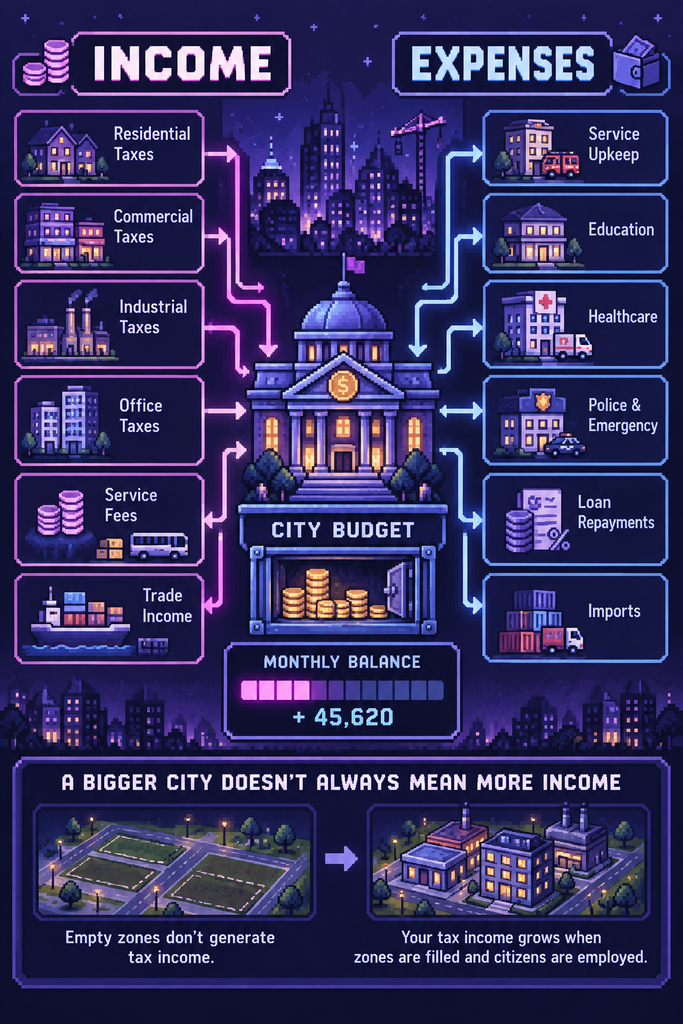
Every city’s income comes from a handful of sources: taxes across your residential, commercial, industrial and office zones, service fees where you’ve enabled them, and trade income once your city starts exporting resources. Expenses run the other direction: service upkeep for every fire station, clinic and school you’ve built, loan repayments if you’ve taken any, and the cost of imports your city can’t produce itself.
The core budgeting problem in Cities: Skylines II is that services scale with your city’s growth, but tax income only scales if your zones are actually filling and your citizens are actually employed. A city that grows its footprint faster than its tax base fills in will bleed money quietly for a long time before it becomes obvious.
📊 Reading the Economy Panel
The Economy panel breaks your finances into income and expenses by category, and the single most useful habit you can build is checking the trend line, not just the current balance. A city can sit on a healthy-looking bank balance while running a negative income trend that will eventually catch up with it.
Chill Place Gaming Store
Take your game further 🎮
Reference sheets, printable guides, and gaming goodies — made by the Chill Place Gaming team to help you play smarter.
Secure checkout
powered by Shopify
Watch for the gap between total income and total expenses widening over a few in-game weeks rather than reacting to a single bad month. One expensive new service building or a temporary dip in trade income isn’t a crisis on its own; a trend that keeps drifting the wrong way for several consecutive checks is worth acting on. Since patch 1.6.2f1 (Autumn Breeze) reworked how citizen finances are calculated (income now drives happiness and spending decisions more directly than raw wealth did before), keeping an eye on citizen income alongside your city’s bottom line has become a more reliable early warning sign than it used to be.
🏷️ Tax Rate Tuning by Zone
Tax rates are set separately for residential, commercial, industrial and office zones, and each has a different tolerance before citizens or businesses start pushing back. Residential taxes are the most sensitive: push them too high and happiness drops, which slows demand and can stall growth in zones you actually want filling in.
Industrial and commercial zones generally tolerate higher rates before resistance kicks in, so if you need to raise revenue, nudging those up before touching residential rates is usually the safer first move. Treat any tax increase as a gradual dial, not a lever, a few percentage points at a time, checking happiness and demand after each change, rather than a single large jump that shocks the whole system at once.
🎚️ Service Budget Sliders: What’s Safe to Trim
Every service in your city, from fire coverage to healthcare to garbage collection, has a budget slider that adjusts how much you’re spending relative to full effectiveness. Running services below 100% saves money, but each one has a different amount of slack before citizens actually notice.
Non-emergency services like garbage collection or park maintenance are usually safe to trim moderately, around 85%, before service quality visibly suffers. Emergency services, fire, police, healthcare, are riskier to cut, since a slow response time during an actual incident has knock-on effects on happiness and land value that cost more than the budget savings were worth. For a fuller breakdown of which services matter most for coverage quality, our guide to understanding city services and coverage areas is worth a read alongside this one.
🏦 Loans: When They Help and How the Debt Spiral Starts
A loan can genuinely help a growing city bridge a gap, funding a big infrastructure project before the tax base that will eventually support it has filled in. Used this way, a loan is a bet on near-future growth, and it’s usually a reasonable one if your city’s underlying trend is healthy.
The debt spiral starts when a loan is used to cover an ongoing deficit rather than a one-time investment. If you’re taking a loan just to keep your existing services running because regular income doesn’t cover regular expenses, that loan repayment becomes another fixed cost stacked on top of a budget that was already struggling, and the next shortfall arrives faster than the last one did. Before taking a loan, ask whether it’s funding growth you expect to pay for itself, or just papering over a gap that will still be there next month.
🔄 Recovery Steps When the Balance Is Already Negative
If you’re already in the red, the first step is identifying which side of the ledger is actually the problem: an income shortfall (zones not filling, low tax rates, lost trade routes) or an expense overrun (over-built services, too many loans, high-cost imports). Pulling the wrong lever wastes time you don’t have.
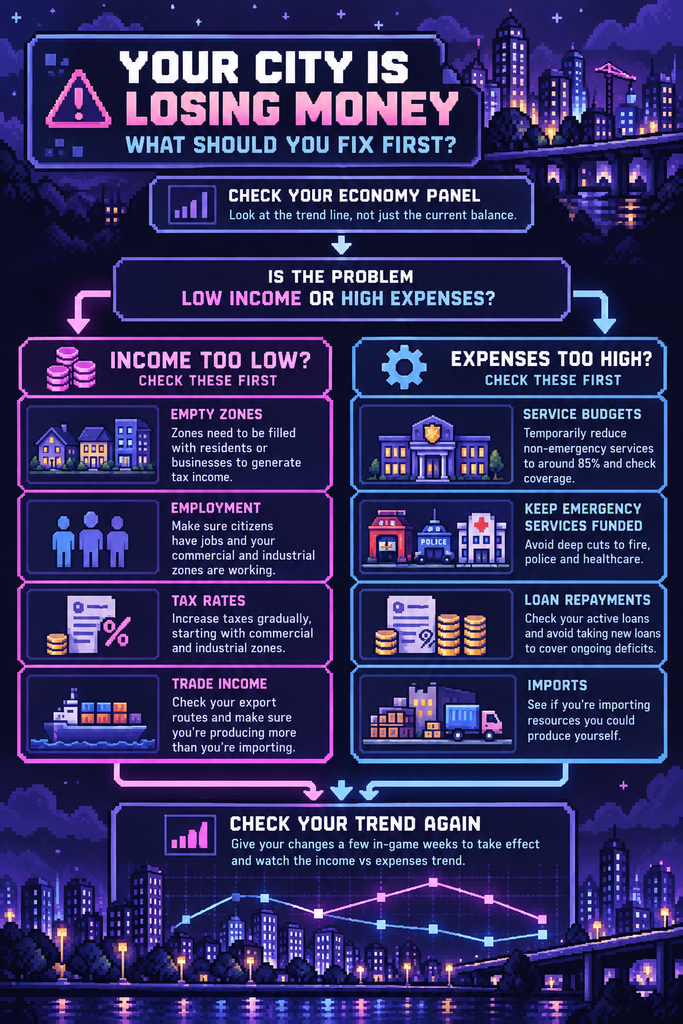
For an income shortfall, check whether unfilled zones are the culprit before you touch tax rates; a lot of empty residential or commercial lots quietly drags down your income relative to your city’s size. For an expense overrun, service budget sliders are your fastest lever, temporarily trimming non-emergency services back toward 85% buys breathing room without an immediate happiness hit. Worth checking too: whether you’ve hit a milestone that unlocked new service tiers or building types you haven’t budgeted for yet, since new unlocks sometimes get built faster than the tax base that should support them.
What actually happens once your balance goes negative is less dramatic than “bankruptcy” might suggest. In the current version, a sustained negative balance mainly means you can’t fund new construction or bigger projects, and existing services start to suffer as their effective budgets get squeezed, rather than triggering a single hard fail state. That’s still worth avoiding, a city stuck unable to build while services degrade is a rough spiral to climb out of, but it’s a recoverable slow squeeze rather than a game-over moment, so there’s time to work the problem calmly using the steps above.
🧭 Keeping Your Budget Healthy Going Forward
The cities that avoid budget trouble aren’t the ones with the lowest tax rates or the most trimmed services, they’re the ones where someone checks the Economy panel’s trend every so often instead of only when the balance turns red. Build that habit early, tune taxes gradually, keep loans tied to genuine growth investments rather than ongoing gaps, and a negative balance becomes a rare correction rather than a recurring fight.
Stop Fighting Traffic.
Start Designing It.
Get the CS2 Road & Junction Toolkit, 11 decision tools for diagnosing jams, picking the right junction, and fixing your city's traffic for good.
- ✓Road hierarchy rules and the 5 mistakes that break them
- ✓A junction selection cheat sheet and a diagnostic flowchart
- ✓A full worked example, before and after


