
As an Amazon Associate I earn from qualifying purchases and sometimes recommend products from other sellers at no extra cost you. For more details see my disclosure policy and privacy policy.
If you went looking for the Railroad Tycoon route, you may have noticed that your Legacy Path screen has gone. Since the Test of Time update (1.4.0), Civilization VII no longer asks you to tick off Economic Legacy Paths and finish with a World Bank. The Economic victory is now a straight contest over GDP, and the way you win it has changed.
This guide covers the route as it works in the current game (1.5.0 and its September hotfix). It also explains what happened to Railroad Tycoon Points, the Great Banker and the World Bank, because plenty of older guides still describe them.
🧭 How Economic Victory Works Now
The official description is short: achieve a Victory by earning the most GDP, which the game also calls Economic Victory Points, over the campaign. GDP is no longer a side effect of a Legacy Path. It is the score the whole victory is built on.
You earn GDP each turn from slotted Resources and Gold Buildings in your Cities. You also earn it by returning Treasure Convoys and by slotting Factory Resources. Those four sources are the whole recipe, so every decision in this guide comes back to feeding them.
Chill Place Gaming Store
Take your game further 🎮
Reference sheets, printable guides, and gaming goodies — made by the Chill Place Gaming team to help you play smarter.
Secure checkout
powered by Shopify
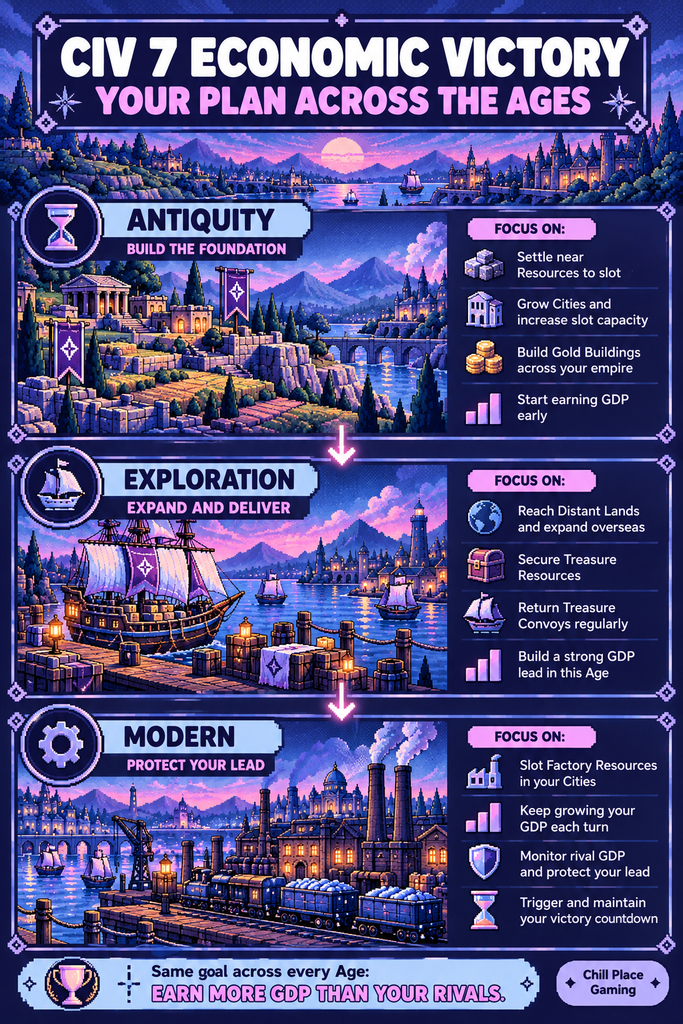
One change matters straight away. Progress toward Economic victory can begin in Antiquity, so there is no longer a point where you wait for the Modern Age to start scoring. If you want the wider picture of how the Ages hand over to each other, our Age Transition guide covers what carries forward.
📏 The Score Lead You Need
Winning is not about reaching a fixed total. You need a lead over the second-place player, and the multiple you need shrinks as the game goes on. Early on the bar is very high, and late on it is much lower.
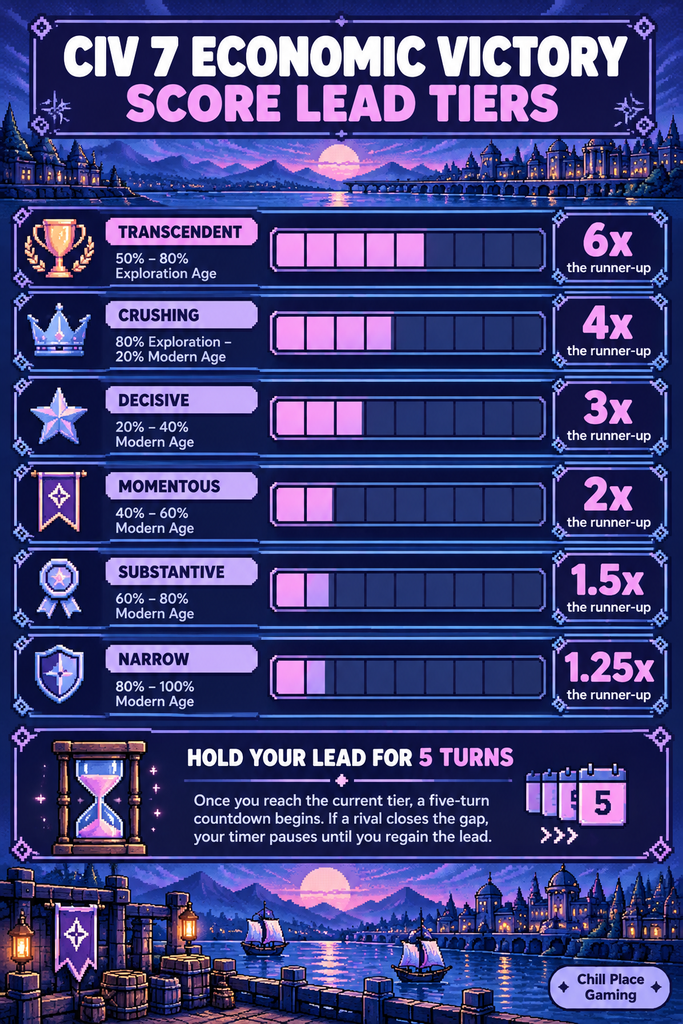
These are the tiers from the official patch notes, with the Age Progress at which each applies:
- Transcendent: 6x the runner-up, at 50% to 80% Age Progress in the Exploration Age
- Crushing: 4x, from 80% of Exploration to 20% of the Modern Age
- Decisive: 3x, at 20% to 40% Modern
- Momentous: 2x, at 40% to 60% Modern
- Substantive: 1.5x, at 60% to 80% Modern
- Narrow: 1.25x, at 80% to 100% Modern
Once you hold the lead for your current tier, a five-turn countdown begins. If a rival closes the gap, your timer pauses until you regain the lead, so it does not reset. That pause is the reason a narrow, late win is far more realistic than a 6x blowout against anyone competent.
If the Modern Age reaches 100% with nobody having won, the highest score takes it. The tiebreakers are turns spent in a Victory countdown, placement across all Victories, and Major Triumphs completed.
💰 The Four GDP Sources and How to Feed Them
The patch notes confirm the sources but do not publish the points each one is worth. I have not been able to verify per-item GDP values, so treat any guide that quotes them with caution unless it names the patch.
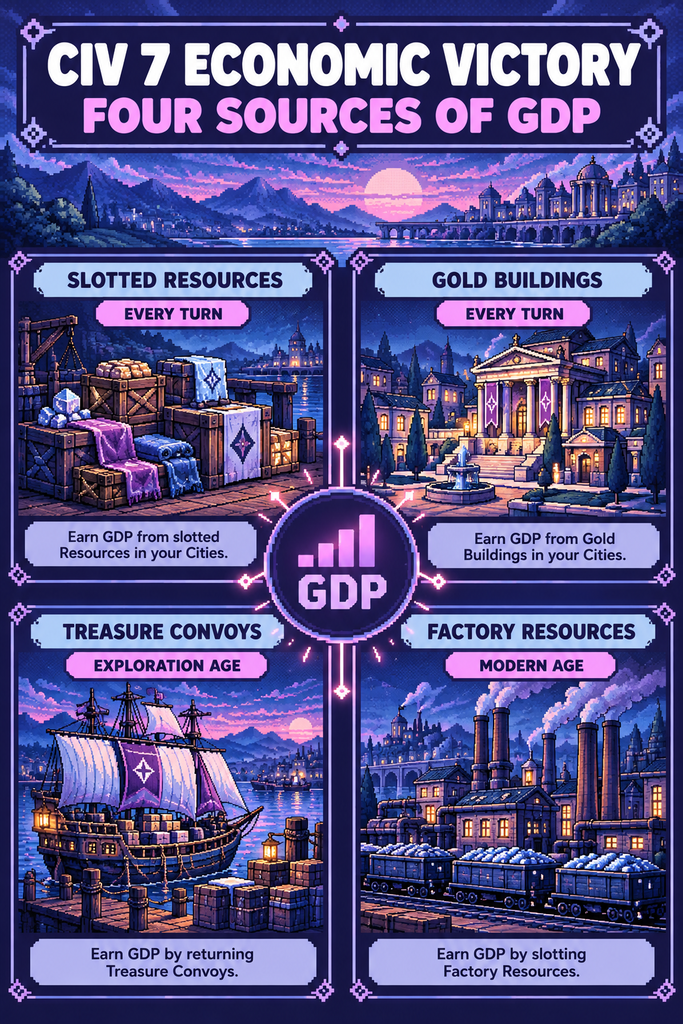
What you can plan around is where GDP comes from. Slotted Resources and Gold Buildings pay out every turn, which makes them the steady base of your score. Treasure Convoys and Factory Resources are the Age-specific engines, one for Exploration and one for Modern.
That split shapes your build order. In Antiquity you are laying the base: settle where there are Resources to slot, and get Cities up to the capacity to hold them. Our Resource Management guide explains which Resources are worth assigning, so I will not repeat it here.
Gold Buildings deserve a second look as well. Under the 1.4.0 notes, Gold and Happiness Buildings no longer need their own Yield as a Maintenance cost, which makes them easier to run in volume. Since they score GDP each turn as long as the City is part of your empire, losing a City costs you more than its output.
🚢 Exploration Age: Treasure Convoys
The Exploration Age is where the economy race is usually decided, because the thresholds start at their highest here. A strong convoy network is the cleanest way to build the lead early. If you fall behind now, the later tiers are the only ones you will realistically reach.
The Commerce Screen has a Treasure view for the Exploration Age. For each Settlement it shows the associated Treasure Resources, the number of active convoys, the value of each, and progress toward the next one. Filled treasure icons mark Distant Lands and hollow ones mark your Homelands.
Two practical points follow from that. First, Distant Lands Settlements are where much of the Treasure sits, so expansion overseas is part of the plan rather than a bonus. Second, convoys now only validate their path on their final move, which stops one ship’s arrival from resetting the whole fleet’s destination.
The September 30 hotfix also guarantees that Treasure Resources spawn in the Exploration Age and Factory Resources in the Modern Age. Before that, they were not guaranteed in the random age-resource selection. If you tried an Economic run on an earlier build and found nothing to slot, that is the likely reason.
🏭 Modern Age: Factory Resources and the Final Push
In the Modern Age the thresholds fall steadily from 3x down to 1.25x, so your job changes from building a lead to protecting one. Slotting Factory Resources adds GDP on top of everything you already earn. This is the part of the old Railroad Tycoon plan that survives.
I could not verify the current Factory and rail requirements from the 1.4.0 to 1.5.0 notes. The notes only say that error messaging for City and Factory Resources and Settlement connections has improved. If a Factory Resource will not slot, the Commerce Screen should now tell you why, so use it before guessing.
Treat the old advice about prioritising Mass Production as unconfirmed for the current build. Check your own tech tree for what unlocks Factories, and slot Factory Resources as early as you can once it appears. The lower the threshold falls, the more every extra turn of GDP is worth.
🤝 Trade, Merchants and Influence
Trade routes feed the Resource side of your score rather than counting as GDP themselves. The Commerce Screen sorts them into Active, Available and Unavailable routes, with reasons given for each. The Unavailable list tells you what a Settlement still needs, which saves a lot of trial and error.
Influence is the cost to watch. The Improve Trade Relations diplomatic action now costs 25% more Influence each time you perform it. If you rely on it to open routes, the price climbs quickly, so spread your efforts across partners instead of repeating it with one.
If your Gold or Influence is running dry before you can build any of this, that is an income problem rather than a victory problem. Our Gold and Economy guide is the place to fix it. Come back here once the treasury is stable.
🏆 Where Triumphs Fit
Triumphs replaced Legacy Paths in Test of Time. They are optional challenges tied to six core Attributes, and Economic is one of them. They are decoupled from Victories, but some grant Victory Points under victory-specific names such as GDP.
Major Triumphs need long-term commitment and grant a Dedication for the next Age. You can activate up to three Dedications in the next Age. In the Modern Age, all Triumphs are Minor, and they act as accelerants that help you close out a Victory or keep pace with a rival.
I could not find an official list of the Economic Triumphs, so I will not name specific ones. Open the Triumphs screen at the start of each Age and pick the ones that line up with the GDP sources above. If you want a refresher on the whole update, our Test of Time breakdown covers it.
📜 What Happened to Railroad Tycoon, the Great Banker and the World Bank
Before 1.4.0, the Economic win was a three-Age Legacy Path. According to older guides, Antiquity asked you to assign 20 Resources to your Settlements, and Exploration asked for 30 Treasure Fleet Points from returning Distant Land Treasures. The Modern Age goal was 500 Railroad Tycoon Points and World Bank Offices in all Capital Cities.
In that system, the Great Banker appeared in your Capital once you hit 500 points. Each World Bank Office then cost Gold and Influence, and the price depended on your relationship with the other civilisation. Those numbers come from third-party guides written for the older build, and I have not been able to confirm them against a current source.
Legacy Paths have been fully replaced by Triumphs in 1.4.0, and the Railroad Tycoon, Great Banker and World Bank terms do not appear in the Test of Time or later patch notes I checked. Do not plan a game around them. The ideas that carried over are slotting Resources, returning Treasure and running Factory Resources, which now feed GDP directly.
⚔️ Rivals, Leaders and Pacing
Because the win depends on a gap, your rivals matter as much as your own economy. A runaway Science or Culture player can hold your multiple out of reach, and the Victory Screen from the HUD shows everyone’s standing in real time. Check it often enough to know whether you are building a lead or defending one.
Leader choice helps too. Our Leader and Civ combinations guide lists the pairings for each victory type, and the Top Tier Civilizations for Different Victory Types post covers the civ side. I will leave the detail to those pages.
You can also turn individual Victory conditions on or off in the game settings since 1.4.2. If you are hosting a game and want the Economic win to be possible without rivals sprinting for Science, that option changes how you plan. For everyone else, it is worth knowing what your lobby has enabled before you commit.
⚠️ Common Mistakes
Most failed Economic runs come from a handful of habits. These are the ones I would watch for:
- Waiting until the Modern Age to start scoring, when GDP can build from Antiquity
- Ignoring Distant Lands, which leaves the Exploration Age convoy engine idle
- Spamming Improve Trade Relations without allowing for the rising Influence cost
- Following an older Railroad Tycoon walkthrough that no longer matches the victory rules
- Ignoring a rival’s score until the countdown has already paused
The common thread is treating the Economic win as an income exercise. It is a scoring contest, and income only matters because it lets you build and slot more. The same discipline carries over to the other victories, which you can compare in our Science victory guide and Culture victory guide.
🏁 Final Thoughts
The Economic victory is easier to read than it used to be. Build a base of slotted Resources and Gold Buildings, add Treasure Convoys in Exploration, add Factory Resources in the Modern Age, and keep an eye on the multiple you need. The five-turn countdown does the rest if you can hold the lead.
Patch details have moved quickly this year, so check the in-game notes before a serious run. The numbers here come from the official patch notes, and where I could not confirm something, I have said so.
🗺️ Continue Your Journey
- Civilization VII Gold and Economy Guide: How to Never Run Out of Money for fixing income problems before you chase a win
- Master Resource Management in Civilization VII for deciding which Resources to slot
- Civilization VII’s Test of Time Update for everything else the update changed
- Civilization VII Age Transition Guide for carrying momentum between Ages
- Cities vs. Towns in Civilization 7 for how Settlement type affects capacity
- Civilization VII Military Victory Guide for dealing with rivals who play for a different win


