
As an Amazon Associate I earn from qualifying purchases and sometimes recommend products from other sellers at no extra cost you. For more details see my disclosure policy and privacy policy.
You have a mid-size city, a healthy bank balance and a zoning map full of colour. Yet the towers refuse to appear, the shops sit at level one and the demand bars for high density stay stubbornly low.
When a city stalls like this, the instinct is to zone more land. In Cities: Skylines II, that is usually the wrong lever. The real lever is land value, and it responds to how pleasant and well connected a neighbourhood is, not to how much of it you paint.
This guide shows you how to read land value, what pushes it up or down, and how to diagnose the most common stalls. It assumes you are past the starter city and want to understand why your districts behave the way they do.
🏘️ What Land Value Actually Does
Land value is a measure of how desirable a spot is for homes and businesses. It feeds straight into rent, and rent feeds into whether a building can afford to level up.
Chill Place Gaming Store
Take your game further 🎮
Reference sheets, printable guides, and gaming goodies — made by the Chill Place Gaming team to help you play smarter.
Secure checkout
powered by Shopify

Here is the chain in plain terms. Higher land value pushes rents up. When rent comfortably covers upkeep, residents or companies have money left over to invest in upgrades, and the building climbs towards level five.
The loop works in reverse too. If residents cannot afford the rent, the building falls behind on upkeep, may be abandoned, and can eventually collapse. Every abandoned building then drags the surrounding land value down with it.
Land value also spreads along roads. A well-served street lifts its neighbours, and a neglected one pulls them down, which is why single good blocks rarely transform a district on their own.
One point from Paradox’s own feature notes is worth keeping in your head. Land value rises when the needs of residents and companies are actually met, so dropping a building on the map does nothing until it is working properly.
🔍 How to Read the Land Value Info View
Open the info views and switch to land value. Use it as a diagnostic map, not just a pretty overlay.
Look for three patterns:
- Dark pockets surrounded by bright areas, which usually point to a local problem such as pollution, noise or a missing service.
- Whole districts that stay dark, which suggests a structural issue like poor transport links or industry placed too close to housing.
- Bright areas full of low-level buildings, which often mean the value is there but demand or education is holding the level-ups back.
Compare the land value view against your building levels and your rent complaints. The gap between the two tells you where to spend your effort.
🏪 Why Businesses Care Too
Land value is not only a housing story. Commercial, industrial and office companies weigh rent against how much they earn, and they also count transport costs for materials, goods and workers.
A site with high rent but poor road access can look worse to a company than a cheaper site on a good route. That is why a shop district with no nearby customers or a workshop with a long haul to the freight network struggles to level up, even when the area looks pleasant.
Higher building levels pay you back. Paradox notes that levels run from one to five, that upkeep and rent rise with each level, and that higher level companies use less utility per unit and create less garbage and pollution. A well-balanced district therefore tends to get cleaner and more efficient as it grows.
Mixed housing, with shops on the ground floor and homes above, helps here. It puts customers next to the counter and keeps trips short, which supports both rent and demand.
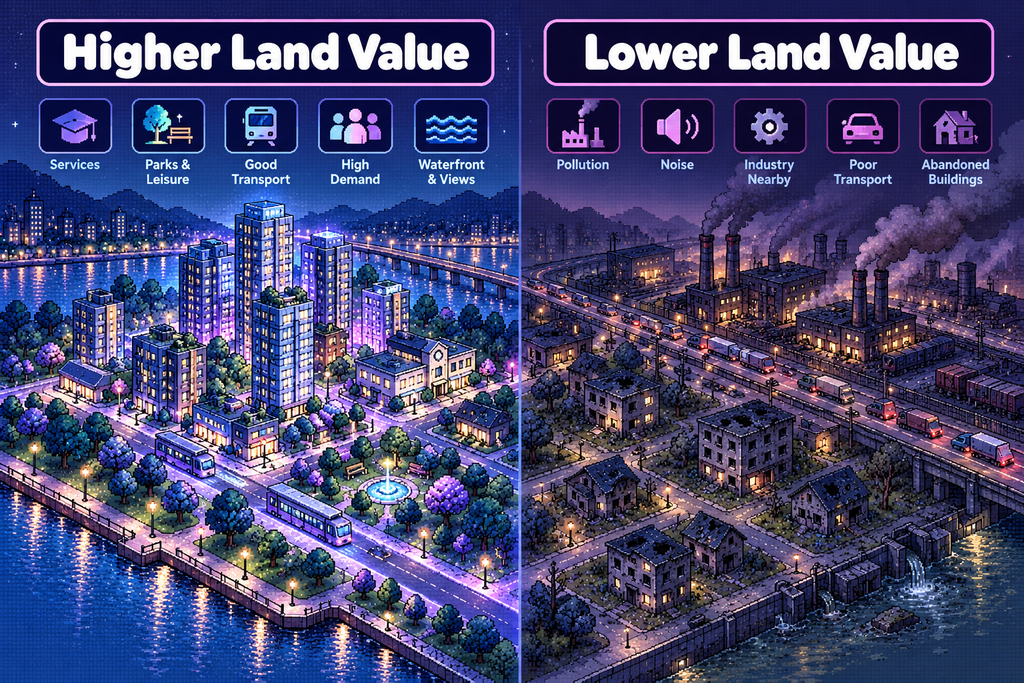
⬆️ What Raises Land Value
Land value responds to the things residents and businesses care about. None of these are secrets, but the order you tackle them in matters.
Service coverage. Schools, healthcare, police, fire and shops all contribute when they actually reach the buildings in question. If you want the detail on how coverage works, our guide to city services and coverage areas in Cities: Skylines II walks through it.
Parks and leisure. Green space and recreation make an area more attractive. Park Adventures arrived in September as part of Expansion Pass 2, so you have more park building options than before. Check how any new park behaves in your own save before building a district around it, because the official notes do not spell out the land value effect.
Transport access. Homes close to jobs and shops, and businesses with cheap routes for goods and workers, rate higher. Well designed roads matter here, and our piece on road hierarchy mistakes that strangle your traffic flow covers how to build them.
Demand pressure. When many people want a type of zone and there is little supply, rent and land value tend to climb. This is why a cramped, popular area can become expensive without any extra help from you.
Waterfront and views. Locations next to water often feel more desirable, though the game does not give exact numbers. Treat it as a bonus to use on premium districts rather than a plan on its own.
⬇️ What Drags Land Value Down
Most stalled cities are held back by what is pulling value down, not by a lack of boosts.
Pollution. Ground, air and water pollution all work against a neighbourhood. If your homes sit downwind of a factory or next to a polluted river, no amount of parkland will fully compensate.
Noise. Busy roads, rail lines and industry make an area less pleasant to live in. A high capacity road running through a residential block is a common culprit.
Industry too close to housing. This combines noise, pollution and traffic in one problem. Our guide to how industry areas work in Cities: Skylines II explains how to place and group production so it stays away from the people it would otherwise bother.
Abandonment. Empty and decaying buildings reduce the value around them. Fix the cause early, because the effect compounds.
Unaffordable rent. If households and companies cannot cover the rent, they leave. Land value that rises faster than incomes will eventually chase people out.
🛠️ Layout and Zoning Moves That Lift Value
Once you know the drivers, a few layout habits make a big difference.
Separate industry from homes. Put your production in its own zone with its own road connections, and keep a buffer of offices, commercial or green space between it and residential areas.
Choose the road to match the street. Fast, wide roads are great for moving goods and bad for quiet housing. Put local streets through residential areas and keep high capacity routes on the edges.
Place parks and plazas where people actually walk. A park tucked behind a factory helps no one, while one in the middle of a dense block gets used.
Use districts to tune policies and services at a neighbourhood level. If one area is struggling, a district lets you adjust it without changing the whole city.
Mix your density. Low density housing is spacious but gets expensive quickly as land value rises, because a single household pays the full rent. Medium and high density spread the cost across more households, which keeps rent more affordable.
📈 How Population Really Grows
Population is not a number you push up by zoning. It is the result of demand, and demand has several inputs.
Residential demand grows when people move in for jobs, education or family life. It falls when unemployment is high or too many homes sit empty.
Patch 1.6.2f1 changed how empty homes are weighed. Residential demand now accounts for city size when measuring the effect of vacancies, which fixed missing residential demand in very large cities.
Jobs and housing need to balance. A city full of homes with too few jobs will hit unemployment, and a city full of jobs with too few homes will starve its employers of workers.
Education unlocks higher density. Better educated citizens fill office and specialised industry jobs, which supports taller, higher level buildings. If you have been neglecting schools, our campus expansion and education building guide is a good place to start.
Taxes and happiness shape how long people stay. The same 1.6.2f1 patch shifted citizen decisions on happiness, shopping and leisure to depend on income rather than savings. If you want a refresher on keeping the books in order, our budgeting 101 guide covers the basics.
🩺 Diagnose and Fix Common Stalls
Here are the four stalls players hit most often, with a first thing to check for each.
Stall: buildings stuck at low levels.
First check whether rent is covering upkeep. If the land value is low, look for pollution, noise and missing services nearby. If land value is fine, look at education and whether shops and jobs are within reach.
Stall: weak demand for high density.
Check education first. High density jobs and homes depend on a workforce with the right skills. Then check that your transport links can handle the extra people, because crowded roads and slow commutes put people off.
Stall: abandonment.
Find out why the residents left. It is usually unaffordable rent, a loss of services, pollution or a lack of nearby jobs. Fix the cause before you bulldoze, because new buildings will fail for the same reason.
Stall: rent too high.
This often comes from land value climbing faster than incomes. Add supply so demand pressure eases, mix in medium and high density homes, and review your residential taxes. Slow down on adding leisure and services in that exact spot until incomes catch up.
🔧 Optional Mods
Mods can adjust land value behaviour, but they are not needed for any of the advice above. Treat them as an optional extra once you understand the base game, and check compatibility with the current patch before installing.
🧪 A Quick Test Routine for Your Next Session
Rather than guessing, run a short test on one district.
- Open the land value info view and note the weakest block.
- Identify the single biggest drag: pollution, noise, a missing service or poor access.
- Fix that one problem and wait a few in-game days to see how rent, happiness and building level respond.
Changing one thing at a time teaches you how the game actually behaves in your save, which is more reliable than any general rule.
📌 Patch Notes on the Current Version
This guide was checked against the current patches. Summer Solstice (1.6.0f1) slightly reduced commercial demand to discourage over-zoning, and Autumn Breeze (1.6.2f1) adjusted residential demand and company renting priorities. Neither patch note mentions land value directly.
That means the core logic here, land value feeding rent and building level, still follows Paradox’s published descriptions. Exact weights and formulas are not public, so test against your own city.
🎯 The Takeaway
Stop asking how much more land to zone and start asking what your neighbourhoods feel like to live in. Clean air, quiet streets, reachable services, jobs nearby and affordable rent do more for your population than another block of zoning ever will.
Pick your weakest district, find the one thing dragging it down and fix that first. Then watch the levels climb.
🚀 Continue Your Journey
- Understanding City Services and Coverage Areas in Cities: Skylines II
- Essential Services Ranking: What to Build First in Cities: Skylines II
- Budgeting 101: How to Avoid Bankruptcy in Cities: Skylines II
- Cities: Skylines II Summer Solstice Patch 1.6.0f1: What Changed and Why It Matters
Stop Fighting Traffic.
Start Designing It.
Get the CS2 Road & Junction Toolkit, 11 decision tools for diagnosing jams, picking the right junction, and fixing your city's traffic for good.
- ✓Road hierarchy rules and the 5 mistakes that break them
- ✓A junction selection cheat sheet and a diagnostic flowchart
- ✓A full worked example, before and after


