
As an Amazon Associate I earn from qualifying purchases and sometimes recommend products from other sellers at no extra cost you. For more details see my disclosure policy and privacy policy.
Civilization VII brings a fresh take on the beloved strategy series with bold new mechanics that both welcome newcomers and challenge veterans. From the three-age system to decoupled leaders and civilizations, this latest entry delivers an experience that feels both familiar and revolutionary.
What’s New in Civilization VII
Firaxis Games has reimagined the Civilization formula with several groundbreaking changes:
- Three-Age System: The game now progresses through Antiquity, Exploration, and Modern Ages, with each transition bringing new strategic choices
- Decoupled Leaders and Civilizations: Players can now choose leaders separately from civilizations, creating unique combinations never before possible
- Towns vs. Cities: Settlements begin as specialized towns (farming, mining, military, trade) that can later be upgraded to full cities
- Commander Units: Military management is more streamlined with Commander units that can stack and move multiple units together
- Crisis Events: Age-ending crises shake up gameplay and prevent players from coasting to victory
- Discovery System: Replacing traditional goodie huts, this system creates a race to claim valuable bonuses through early exploration
- Legacy Paths: Specialized achievement tracks that guide your civilization toward different victory conditions
What’s Your Favorite New Feature in Civilization VII?
Deep Dive: The Age System
The three-age structure fundamentally changes how Civilization plays. Each age feels distinct, with its own rhythm and strategic priorities:
| Age | Key Features | Strategic Focus |
|---|---|---|
| Antiquity | Town founding, early discoveries, establishing production | Exploration, claiming resources, basic infrastructure |
| Exploration | Legacy paths emerge, expanding territory, crisis preparation | Developing specializations, economic growth, military expansion |
| Modern | Advanced technologies, victory path focus, global competition | Finalizing victory strategy, managing international relations |
Antiquity Age focuses on establishing your foothold in the world. Early decisions about town placement and specialization are crucial, as resources are more strategically important than ever. Your initial scouting reveals not just the map but also valuable discoveries that can accelerate your development. The military focus is primarily defensive, protecting your growing civilization from barbarians and aggressive neighbors.
Chill Place Gaming Store
Take your game further 🎮
Reference sheets, printable guides, and gaming goodies — made by the Chill Place Gaming team to help you play smarter.
Secure checkout
powered by Shopify
Exploration Age shifts the focus to expansion and specialization. With basic infrastructure established, you’ll need to develop your legacy path and prepare for potential crises. Trade routes become essential for economic growth, and military strategies grow more complex with the introduction of Commander units. The choices you make here will strongly influence your path through the final age.

Modern Age culminates your civilization’s journey, with advanced technologies and global competition. Your earlier decisions in legacy paths come to fruition here, as you pursue your chosen victory condition against increasingly challenging AI opponents. The game accelerates in this phase, with diplomatic, cultural, and military interactions reaching their peak intensity.
These changes create a dynamic experience where your early-game decisions have meaningful impact on mid and late-game strategies, while still allowing for adaptation to changing circumstances.
Perfect for New Players
For those new to the Civilization series, VII offers the most accessible entry point yet:
- Improved Tutorials: The in-game advisor system provides clear guidance without overwhelming new players
- Recommended Starting Setup: Begin with Hatshepsut in the Antiquity Age on the lowest difficulty (Scribe) to learn the basics
- Gradual Complexity: The game introduces new mechanics at a manageable pace, letting you master concepts before adding more
- Production Focus: Early emphasis on production buildings like the Saw Pit and Brickyard accelerates growth
Beginner’s Strategy Guide
If you’re just starting out, follow this simple path to success:
First 20 Turns:
- Build a Scout immediately, followed by a Warrior for defense
- Research Animal Husbandry first to reveal horses, then Pottery for granaries
- Focus on claiming discoveries with your Scout before rival civilizations
- Found a farming town near wheat, rice, or cattle if possible
- Build a Saw Pit in your capital to boost production
Early Town Development: Each town specialization offers unique advantages:
- Farming Towns: Best near rivers and food resources, they generate population growth bonuses
- Mining Towns: Ideal near hills and strategic resources, they boost production of units and buildings
- Military Towns: Position these at strategic border locations to quickly produce defensive units
- Trade Towns: Place along coastlines or river routes to maximize gold income
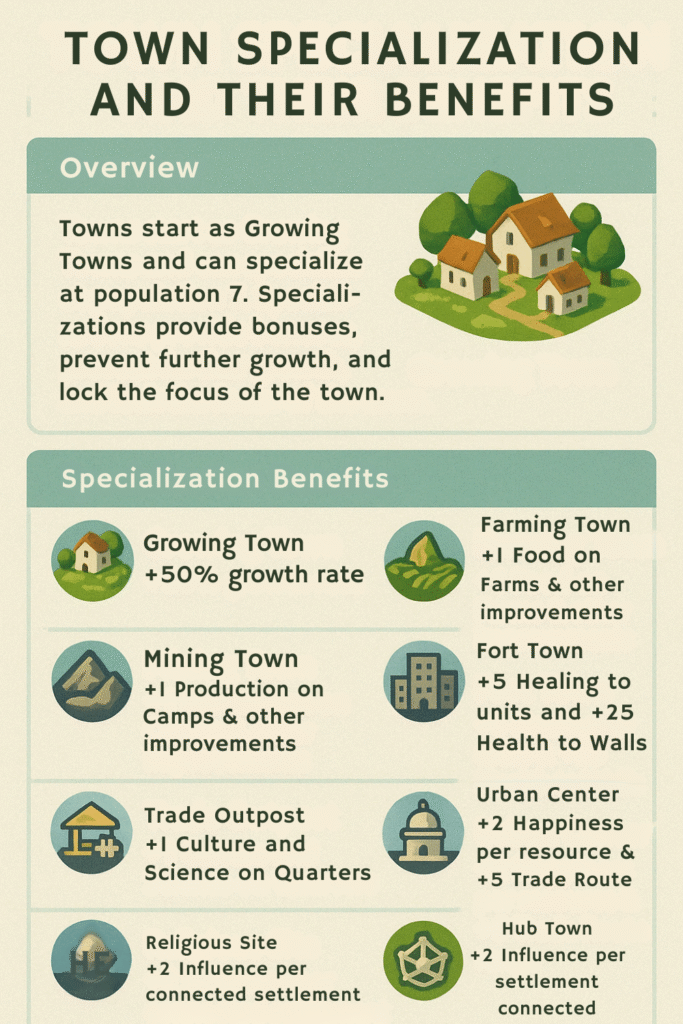
Your capital should always prioritize production buildings first, as these allow faster development of everything else. The initial Saw Pit leads to the Brickyard, which together form the foundation of your early infrastructure.
Remember that towns convert their production directly into gold, which you then use to purchase units and buildings. This system rewards good economic management and town placement that complements resource availability.
Veterans Will Need to Adapt
Longtime Civilization players will find that VII demands new approaches:
- Strategic Flexibility: The ability to change civilizations between ages rewards adaptability over rigid planning
- Legacy Paths: Pursuing specific achievements creates new strategic layers and encourages varied playstyles
- More Aggressive AI: Even peaceful victory paths require stronger military presence than in previous games
- Discovery System: The replacement for goodie huts creates a race for early exploration and rewards
For Experienced Players: What’s Different
If you’ve mastered previous Civilization games, prepare to adjust your strategies considerably:
Production and Growth: The town system fundamentally changes how you’ll approach expansion. Rather than founding cities everywhere possible, you’ll need to be more strategic about town placement and specialization. Each town contributes to your economy differently, and upgrading towns to cities requires significant investment.
Leader-Civilization Combinations: Experiment with unexpected leader-civilization pairings. For example, Benjamin Franklin leading China creates a unique blend of diplomatic and scientific advantages that wasn’t possible in previous games. Some powerful combinations we’ve discovered:
- Hatshepsut with Rome for exceptional early production
- Genghis Khan with France for surprising cultural power backed by military might
- Elizabeth I with Japan for naval dominance and trade wealth

Which Leader-Civilization Combination Works Best?
Military Tactics: The Commander system changes battlefield dynamics significantly. These special units allow you to group and move multiple units together, creating formations that can quickly respond to threats. This means fewer units can control more territory, but also requires more thoughtful strategic positioning.

Crisis Management: The age-ending crises force even the most experienced players to adapt. These events can range from climate disasters to civil unrest or foreign invasions. Having contingency plans and resources set aside specifically for crisis management is essential. Each crisis requires adopting special policies that might introduce disadvantages you’ll need to work around.

Visual and Audio Design
Civilization VII sports a refreshed visual style that balances clarity with aesthetic appeal. The map, units, and UI elements are all designed to provide immediate gameplay information while maintaining the series’ grand scope and historical gravitas.
Sound design deserves special mention, with an adaptive soundtrack that evolves with your civilization and excellent voice acting for leaders and advisors that adds personality to each interaction.
Graphics and Performance
The game’s visuals strike an excellent balance between detail and performance. On mid-range hardware, we maintained a steady 60 FPS throughout most of our playtime, with only occasional dips during crisis events or when viewing extremely large maps in the late game.
The art direction makes a subtle but meaningful shift from Civilization VI’s somewhat cartoonish style to a more refined aesthetic that still retains readability. Unit designs are instantly recognizable but feature more historical detail, while leaders have more nuanced animations and expressions during diplomatic interactions.
Environment effects deserve particular praise. Weather systems are not just visually impressive but serve gameplay functions – storms can delay military movements, while seasonal changes affect food production in certain biomes. The day/night cycle adds both visual variety and strategic considerations, with some units receiving bonuses during specific times.
User Interface Improvements
The UI receives a complete overhaul focused on reducing the learning curve:
- Clearer iconography with more distinct shapes and colors
- Contextual tooltips that provide increasingly detailed information based on how long you hover
- Streamlined menus that group related functions more logically
- New alert system that prioritizes notifications based on urgency and player preferences
The tech and civic trees are particularly well-designed, with visual pathways that make progression goals immediately understandable even for new players.
What Works Well
Many of Civilization VII’s innovations succeed brilliantly:
- Replayability: The combination of different leaders, civilizations, and legacy paths creates nearly endless variety
- Strategic Depth: Decoupling leaders from civilizations opens up creative combinations with unique strengths
- Streamlined Military: The Commander system makes managing large armies less tedious without sacrificing tactical options
- Visual Clarity: The new UI makes it easier to track important information and make informed decisions
Areas for Improvement
Not every new feature hits the mark:
- Crisis Balance: Some crises can feel disproportionately punishing depending on your chosen strategy
- Age Transitions: The shift between ages sometimes feels abrupt rather than a natural progression
- Learning Curve: While newcomers are well-served, veterans may find the initial adjustment frustrating
- Town Specializations: The different town types could use more distinctive advantages to make choices more meaningful
Balance Issues and Potential Fixes
After extensive gameplay, we’ve identified several areas where Civilization VII could use refinement in future updates:
Crisis Severity: The Exploration Age crisis often feels significantly more punishing than the Antiquity crisis, creating an uneven difficulty curve. Some crises like the “Resource Scarcity” event can effectively end a game if you’re pursuing certain strategies. A tiered crisis system that scales with player performance would create a more balanced experience.
Civilization Switching: While the concept of changing civilizations between ages is innovative, the transition can feel jarring from a narrative perspective. Some civilizations also feel substantially more powerful in certain ages, creating obvious “best choices” that limit strategic diversity. More balanced civilization abilities across all ages would improve this system.
AI Behavior: The more aggressive AI is generally welcome, but it sometimes makes puzzling decisions, like declaring war despite being massively outmatched militarily or refusing reasonable peace terms. The diplomatic system could use more transparency to help players understand AI motivations and reactions.
User Interface Quirks: While generally improved, some interface elements still need work:
- Town management screens could better highlight specialization benefits
- The crisis warning system gives too little time to prepare effectively
- Legacy path progress indicators are sometimes unclear about requirements
Recommended Strategies for Success
Based on our extensive playtime, here are key tips for Civilization VII mastery:
- Scout Rush: Build multiple scouts early to claim discoveries before rivals
- Production Focus: Prioritize production buildings in your capital city
- Strategic Town Placement: Plan town specializations based on nearby resources
- Crisis Preparation: Always have contingency plans for age-ending crises
- Military Presence: Maintain a stronger military than in previous Civilization games
Advanced Strategy Tips
For players looking to master Civilization VII, these detailed strategies will help you dominate at higher difficulty levels:
Optimal Antiquity Age Setup: Starting choices significantly impact your entire game. Consider these proven openings:
- Scout → Warrior → Settler → Trader (balanced approach)
- Scout → Scout → Warrior → Trader (discovery-focused)
- Warrior → Warrior → Scout → Settler (defense-focused for aggressive neighbors)
Always research Animal Husbandry first, followed by either Pottery (for food-rich starts) or Mining (for hill-heavy maps).
Legacy Path Selection: Each legacy path offers different advantages for victory conditions:
- Cultural Legacy: Focus on wonders and developing Theater districts early
- Scientific Legacy: Prioritize Campus districts and tech-boosting discoveries
- Domination Legacy: Invest in Commander units and military towns
- Diplomatic Legacy: Establish early trade routes and focus on alliance-building

Commander Unit Formations: The new Commander system allows for powerful unit combinations:
- Pair ranged units with melee units for balanced attack capabilities
- Group siege units with defensive units to protect your city-busters
- Create specialized naval squadrons with a mix of melee and ranged ships
Crisis Management Playbook: For each potential crisis, have these preparations ready:
- Climate Crisis: Stockpile food and prepare gold reserves for emergency repairs
- Civil Unrest: Maintain gold reserves and prepare military units for rebellions
- Foreign Invasion: Establish defensive positions at key border choke points
- Resource Scarcity: Diversify resource access through trade deals before the crisis hits
When properly managed, some crises can actually become opportunities to pull ahead of less-prepared opponents.
| Feature | Civilization VI | Civilization VII | Our Assessment |
|---|---|---|---|
| Leader-Civ Relationship | Fixed pairs | Leaders and civs chosen separately | Major improvement: creates far more strategic options |
| Age Structure | Many short eras | Three long ages (Antiquity, Exploration, Modern) | Different but interesting: creates distinct game phases |
| City Founding | Cities only | Towns (upgrade to cities, specializations) | More strategic depth in expansion decisions |
| Early Exploration | Goodie huts/barbarian camps | Discovery system—race for rewards | More dynamic: creates meaningful early game competition |
| Crises | Not present | Age-ending crisis events | Interesting but needs balancing: some are too punishing |
| Military Management | Unit stacking limited | Commanders allow grouped movement | Greatly improved: reduces micromanagement |
| Victory Conditions | Multiple parallel paths | Legacy-influenced victory paths | More interconnected: early choices affect later options |
| User Interface | Complex, information-dense | Streamlined, contextual information | Clearer: better for new players without sacrificing depth |
The Verdict
Civilization VII represents a bold evolution for the series that mostly succeeds in its ambitions. While some mechanics may need fine-tuning in future updates, the core experience delivers the addictive “one more turn” gameplay that has defined Civilization for decades, wrapped in fresh systems that encourage experimentation and adaptation.
For both newcomers and veterans willing to adapt, Civilization VII offers a deeply satisfying strategy experience that will likely remain engaging for years to come.
Score: 9/10
Standout Moments
During our hours with Civilization VII so far, several memorable gameplay moments stood out:
An Antiquity Age crisis involving volcanic eruptions completely reshaped our strategy. What began as a disaster (losing two valuable towns) turned into an opportunity when the newly fertile volcanic soil allowed us to create the most productive farming town in our empire.
The leader-civilization combination of Elizabeth I with Japan created an unexpected naval powerhouse. By focusing on the Maritime legacy path, we dominated coastal regions and established trade networks that generated so much wealth that we could purchase a new building or unit almost every turn in the Modern Age.
One particularly tense game came down to a race between our Science Victory and an opponent’s Cultural Victory. The three-age structure created a natural dramatic arc, with the final age becoming an exciting sprint to the finish line where every decision mattered.
Value Proposition
At its launch price of $59.99, Civilization VII offers exceptional value for strategy fans. With multiple difficulty levels, countless leader-civilization combinations, and the endless replayability that comes from procedurally generated maps, you’ll easily get hundreds of hours of entertainment. The learning curve for new systems is well worth the investment, as it creates a refreshed experience even for players who have exhausted previous entries in the series.
Related Articles from Chill Place Gaming
- Gamer News: December 2024 – Catch up on the latest gaming news, including Civilization VII updates
- 10 Things You Need to Know About Warhammer: Space Marine 2 – Another strategic action game worth checking out
- Best Cozy Games to Play During Winter: Xbox and PC – When you need a break from intense strategy
- A Guide to Xbox’s Backward Compatibility – Play older Civilization titles on your newest console
- Hidden Gems on Xbox Game Pass You Need to Play – More strategy games available through subscription
Community Discussion: Your Turn
We want to hear from you! Which new feature in Civilization VII has had the biggest impact on your gameplay experience? Are you finding the three-age system refreshing or restrictive? Which leader-civilization combinations have you discovered that work particularly well together?
Have you been playing Civilization VII? Share your strategies and thoughts in the comments below!


