
As an Amazon Associate I earn from qualifying purchases and sometimes recommend products from other sellers at no extra cost you. For more details see my disclosure policy and privacy policy.
Starting your first city in Cities Skylines II can feel overwhelming with so many map choices. The vanilla maps offer vastly different terrain, resources, and challenges that will shape your entire city-building experience.
The best maps for beginners prioritize flat terrain, large buildable areas, and abundant resources. These features minimize early-game frustrations while you’re still learning traffic management, service placement, and economic systems. Let’s explore which maps will give you the smoothest start.
What Makes a Map Beginner-Friendly?
Before we rank specific maps, understanding the key factors will help you make informed choices for future playthroughs. These elements determine how quickly you can expand and how forgiving early mistakes will be.
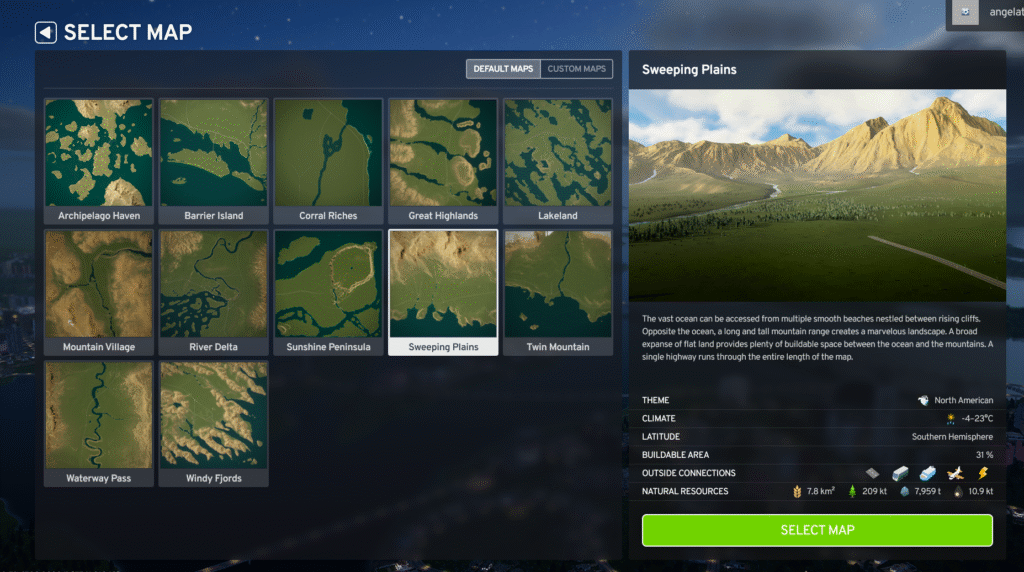
Buildable Area Size: More space means room for experimentation without immediate constraints. Larger maps let you spread out districts and fix layout problems without demolishing everything. You’ll appreciate this breathing room when learning your first city fundamentals.
Chill Place Gaming Store
Take your game further 🎮
Reference sheets, printable guides, and gaming goodies — made by the Chill Place Gaming team to help you play smarter.
Secure checkout
powered by Shopify
Terrain Flatness: Mountains look beautiful but create headaches for new players. Flat terrain simplifies road layouts, reduces construction costs, and makes service coverage easier to manage. You can always tackle mountainous maps once you’ve mastered the basics.
Resource Accessibility: Fertile land, forestry, ore, and oil near your starting tile accelerate early economic growth. Quick access to resources means faster income, which gives you more flexibility to experiment with different city layouts and service placement strategies.
Outside Connections: Highway, rail, ship, and air connections enable trade and tourism. Maps with all connection types provide maximum economic flexibility. This becomes especially important as your city grows beyond the initial tile.
Water Features: Rivers and coastlines simplify sewage management and power generation. They also create natural boundaries that can guide your city’s growth patterns. Just ensure you have enough flat land near water sources for early development.
Top 5 Beginner-Friendly Vanilla Maps
1. Lakeland – The Perfect Starting Point
Lakeland consistently ranks as the best beginner map for good reason. The central lake provides ample water for utilities while the surrounding terrain offers generous flat buildable space. Mixed climate conditions (-15°C to 26°C) teach you seasonal management without extreme weather challenges.
The map includes road, rail, air, and power connections from the start. You’ll have 12.3 km² of buildable area, giving you plenty of room to expand before hitting boundaries. The balanced resource distribution means you won’t struggle with early money problems.
New players should start here to learn road hierarchy principles and progression system mechanics without terrain complications.
2. Barrier Island – Flat and Flexible
Barrier Island delivers the flattest terrain in the base game with 12.4 km² of buildable area. The island layout creates natural development zones while keeping everything manageable. Sunny climate (10-29°C) means consistent conditions without seasonal surprises.
All outside connections come standard, and the flat terrain makes this ideal for learning traffic solutions. Bridge construction adds mild complexity without overwhelming you. The gentle introduction to water management works perfectly for beginners.
This map shines for players who want to focus on city layout and traffic optimization rather than fighting terrain challenges.
3. Coral Riches – Maximum Space for Expansion
With 36.9 km² of buildable area, Coral Riches offers the most room for growth. Flat terrain and abundant resources (fertile land, forestry, ore, and coal) near the starting tile mean rapid early development. Sunny climate with wider temperature range (3-34°C) adds variety without extreme difficulty.
The massive space lets you experiment freely with different district layouts and city planning approaches. You can make mistakes and learn from them without running out of space for corrections.
Choose this map if you want maximum freedom to explore different building strategies without spatial constraints.
4. Waterway Pass – Strategic River Development
Waterway Pass combines 15.5 km² of buildable area with central river features and mountain borders. The river creates natural development zones while providing utility benefits. All outside connections support varied economic strategies.
The slightly more complex terrain teaches you to work with natural features rather than fighting them. This prepares you for more challenging maps while remaining forgiving. The balance between flat areas and mild terrain variation makes it excellent for intermediate beginners.
This works well as your second or third map choice after mastering completely flat terrain basics.
5. Great Highlands – Scenic But Manageable
Great Highlands offers 12.4 km² across mountainous terrain with river valleys. Mixed climate (-3°C to 19°C) and all connections provide full gameplay options. While more challenging than purely flat maps, the scenic environment teaches terrain adaptation without overwhelming difficulty.
The valleys offer natural flat zones for initial development. Once you’ve established these areas, you can expand into hillier regions. This gradual complexity increase helps bridge the gap between beginner and intermediate maps.
Consider this map once you’re comfortable with basic mechanics and ready for mild terrain challenges.
Cities Skylines II – Vanilla Maps Guide
Complete comparison of base game maps with beginner-friendly recommendations
| Map Name | Climate | Buildable Area | Outside Connections | Notable Features |
|---|---|---|---|---|
| Lakeland Top Pick | Mixed -15°C to 26°C |
12.3 km² |
Road
Rail
Air
Power
|
Central lake, scenic environment, balanced resources, excellent for learning basics |
| Barrier Island Best for Flat Terrain | Sunny 10°C to 29°C |
12.4 km² |
Road
Rail
Ship
Air
Power
|
Flattest terrain, islands layout, perfect for traffic optimization practice |
| Coral Riches Maximum Space | Sunny 3°C to 34°C |
36.9 km² |
Road
Rail
Ship
Air
Power
|
Largest buildable area, flat open land, abundant resources near start |
| Waterway Pass Good Balance | Sunny -5°C to 36°C |
15.5 km² |
Road
Rail
Ship
Air
Power
|
Mountain borders, central river, strategic development zones |
| Sunshine Peninsula | Sunny 11°C to 27°C |
64.8 km² |
Road
Rail
Ship
Air
Power
|
Largest map overall, some terrain variation, maximum expansion potential |
| Great Highlands | Mixed -3°C to 19°C |
12.4 km² |
Road
Rail
Ship
Air
Power
|
Mountainous, scenic valleys, moderate difficulty for beginners |
| River Delta | Sunny -4°C to 34°C |
13.4 km² |
Road
Rail
Ship
Air
Power
|
Wide river, fertile banks, strong resource access |
| Sweeping Plains | Mixed -4°C to 23°C |
7.8 km² |
Road
Rail
Ship
Air
Power
|
Open plains, minimal terrain management, smaller space |
| Mountain Village | Mixed -12°C to 27°C |
11.8 km² |
Road
Rail
Air
Power
|
Surrounded by mountains, challenging terrain, scenic views |
| Twin Mountain | Mixed -4°C to 15°C |
7.8 km² |
Road
Ship
Air
Power
|
Valleys, challenging terrain, advanced players only |
| Archipelago Haven | Rainy 8°C to 30°C |
11.4 km² |
Road
Rail
Ship
Air
Power
|
Multiple islands, lower buildable area, unique challenge |
| Windy Fjords | Mixed -6°C to 18°C |
8 km² |
Road
Rail
Ship
Air
Power
|
Fjords, varied elevation, scenic but challenging |
Buildable Area Guide
Beginner Recommendation: Start with Lakeland or Barrier Island for the best learning experience. These maps balance buildable space, resources, and manageable terrain complexity.
Additional Strong Beginner Options
Sweeping Plains: Features wide open flat areas minimizing terrain management. With 7.8 km² of buildable space, it’s smaller but extremely forgiving for learning zoning basics. The straightforward layout helps you focus on service placement and road networks without distractions.
Sunshine Peninsula: The largest buildable area at 64.8 km², though some terrain variation exists. Sunny climate and all connections make this viable for ambitious beginners who want maximum expansion room. The sheer space available means you’ll never feel constrained during learning.
River Delta: Wide river with fertile banks and 13.4 km² of buildable area. The flat terrain near the river provides excellent early development space. Strong resource access supports rapid economic growth, which helps offset any early mistakes.
Tips for Your First Map Choice
Start with Lakeland or Barrier Island for your absolute first city. These maps minimize complications while teaching core mechanics. You’ll learn traffic management, service coverage, and economic basics without terrain adding extra difficulty layers.
Preview different tiles before committing to your starting location. Look for flat areas near water and resources. The starting tile choice matters as much as the map selection itself. Understanding progression systems helps you plan which tiles to unlock first.
Don’t worry about making the “perfect” choice. Every map teaches valuable lessons, and you’ll want to try multiple maps anyway. Each playthrough builds your city-building skills regardless of the specific terrain challenges.
Once you’ve successfully built a city past 50,000 population on a beginner map, you’re ready to explore more challenging terrain. The skills you develop on flat maps transfer directly to complex mountainous regions. For deeper strategy insights, explore our simulation game beginner’s guide for broader city-building principles.
Resources for Success
The official Cities Skylines II wiki provides detailed technical specifications for all vanilla maps. Paradox Interactive’s map features overview explains the design philosophy behind each location.
Community resources on Steam Community and GameRant’s beginner map guides offer additional perspectives from experienced players.
Start with these beginner-friendly maps, master the fundamentals, and you’ll be ready to tackle any terrain the game offers. Your city-building journey begins with choosing the right foundation—pick a forgiving map and focus on learning the systems that matter.
Stop Fighting Traffic.
Start Designing It.
Get the CS2 Road & Junction Toolkit, 11 decision tools for diagnosing jams, picking the right junction, and fixing your city's traffic for good.
- ✓Road hierarchy rules and the 5 mistakes that break them
- ✓A junction selection cheat sheet and a diagnostic flowchart
- ✓A full worked example, before and after


