
As an Amazon Associate I earn from qualifying purchases and sometimes recommend products from other sellers at no extra cost you. For more details see my disclosure policy and privacy policy.
Civilization VII introduces one of the most significant gameplay innovations in the series’ history: the ability to select leaders and civilizations independently. This new system completely transforms how you approach your strategy, opening up countless possibilities for customization and tactical depth. Let’s explore how this system works and how you can use it to your advantage.
Updated for Test of Time. Civilization VII’s Test of Time update (1.4.0) added Time-Tested Civs, letting you stay on one civilization for an entire campaign instead of switching at every Age transition. Age-switching, the system this guide is built around, is still fully in the game and still a valid way to play. The pairings and strategy below are written for players switching civilizations between Ages. If you’re playing Time-Tested instead, your leader stays fixed and your Syncretism/Affirmation choice each Age becomes the new decision point, which is a different strategic conversation we’ll cover separately.

The New Selection System Explained
In previous Civilization games, each civilization came with a fixed leader. Civilization VII breaks this mold by allowing you to mix and match, creating combinations that might never have existed historically.

Here’s how it works:
Chill Place Gaming Store
Take your game further 🎮
Reference sheets, printable guides, and gaming goodies — made by the Chill Place Gaming team to help you play smarter.
Secure checkout
powered by Shopify
- Independent Selection: You choose your leader and civilization separately at game start
- Age Progression: The game divides history into three distinct periods, Antiquity, Exploration, and Modern
- Civilization Transitions: As you advance through Ages, you can swap to a new civilization that better suits your evolving strategy, or since Test of Time, choose to stay on your current civilization the whole game as a Time-Tested civ
- Historical Connections: Your choices for the next Age’s civilization may be limited by geographical or historical connections to your current one
This system wasn’t just designed for historical fantasy, it creates meaningful strategic choices that evolve as your game progresses.
Strategic Impact of Leader-Civilization Pairings
The mix-and-match system fundamentally changes how you approach victory:
Synergy Creation
By carefully pairing leaders with complementary civilizations, you can create powerful combinations that amplify your strengths. For example:
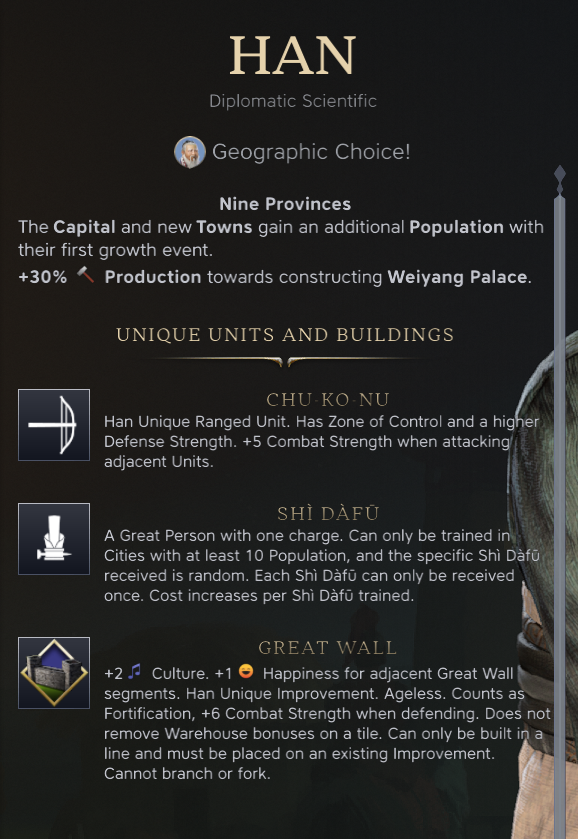
- Science Focus: Pairing Confucius (who generates Science from Specialists and city growth) with Han China (which boosts population and Influence) creates an unstoppable tech powerhouse
- Military Dominance: Combining Trung Trac’s Commander training bonuses with Rome’s Legions gives you formidable military capabilities

Strategic Flexibility
The ability to transition between civilizations as you progress through Ages means you can adapt your strategy to changing circumstances:
- Start with a civilization strong in early expansion during Antiquity
- Transition to one with powerful naval or colonial abilities in the Exploration Age
- Finish with a civilization that excels at late-game victory conditions in the Modern Age
Snowball Potential
Many of these combos can create powerful advantages early that multiply over time:
- Early military success with Trung Trac + Rome can lead to territorial control that ensures dominance throughout the game
- Economic foundations built with Xerxes + Aksum provide flexibility to pivot to any victory condition as opportunities arise
- Scientific leads established with Confucius + Han can keep you ahead in the tech race throughout all Ages
Powerful Leader-Civilization Combinations
Based on extensive gameplay analysis, these combinations have proven particularly effective:
Top Leader-Civilization Pairings
| Leader | Civilization | Why This Combo is Powerful |
|---|---|---|
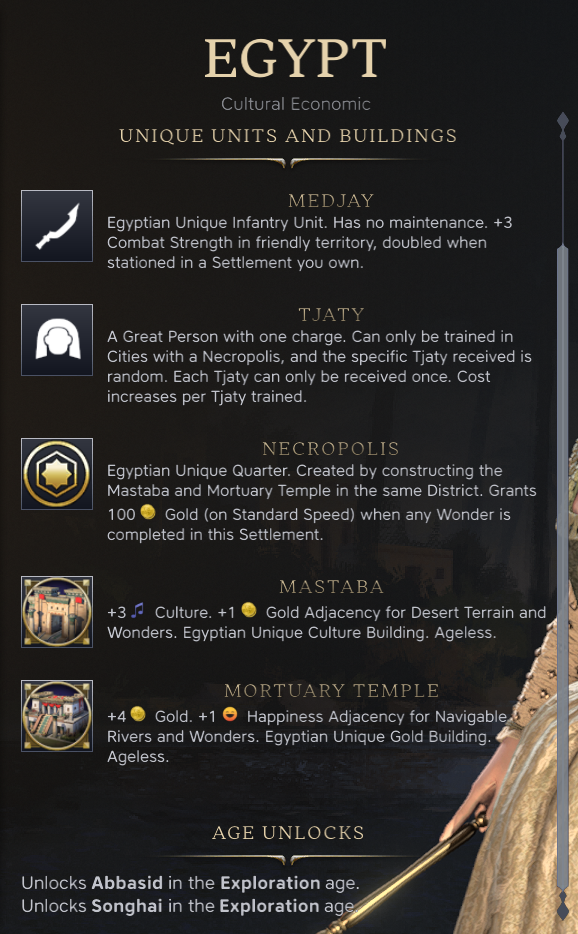
| Catherine the Great | Egypt | Catherine’s Culture focus synergizes with Egypt’s strong Culture and Gold output. Extra Great Work slots and culture can be converted into Science, enabling rapid tech progress while maintaining cultural strength. |
| Confucius | Han | Confucius boosts city growth and specialist yields, while Han’s population bonuses and Influence buffs further amplify Science and specialist output. This makes for a science powerhouse that scales well into later ages. |
| Trung Trac | Rome or Persia | Trung Trac’s early-game strength now comes through Trung Nhi, her unique Commander unit with a bespoke promotion tree (bonuses like Jungle Warfare, Mettle and Courage, and Hai Bà Trung for defensive strength). Paired with Rome’s Legions or Persia’s Immortals, she still enables early conquest and snowballing military dominance, just via a different mechanic than before. |
| Xerxes (The Achaemenid) | Aksum | Xerxes’ trade route and economic bonuses combine with Aksum’s ability to rapidly accumulate Gold for a strong early economy. His Settlement Limit bonus was rebalanced in Test of Time to a flat +1 per Age (max +3, down from cumulative scaling up to +6), so lean on the trade and Gold side of this pairing rather than planning around a wide settlement count. |
| Ashoka (World Conqueror) | Maurya | Ashoka’s Happiness Adjacency now applies to Happiness, Food, and Unique Buildings rather than all Buildings, and his Celebration bonus scales with Settlement happiness tier (bigger Food bonus in Joyous and Ecstatic Settlements than in merely Happy ones). Combined with Maurya’s happiness and celebration mechanics, this still supports rapid expansion, but the payoff now depends more on actively pushing Settlements up the happiness tiers. |
| Machiavelli | Greece | Machiavelli’s Influence and Gold from diplomatic actions, combined with Greece’s Influence and city-state bonuses, allow you to dominate diplomacy and city-state integration, fueling both expansion and economic growth. |
Synergy Deep Dives
Catherine the Great + Egypt: Focus on building and filling Great Work slots to maximize Culture, which Catherine can convert into Science. Egypt’s Gold output allows you to buy buildings and units, accelerating both cultural and scientific progress.s you to buy buildings and units, accelerating both cultural and scientific progress.
Confucius + Han: Grow your cities quickly, generate more specialists, and use Han’s Influence bonuses to collaborate on research, leading to rapid scientific advancement and a strong specialist economy.
Trung Trac + Rome: Lean on Trung Nhi, Trung Trac’s unique Commander, to carry the early game. Her bespoke promotion tree rewards aggressive, sustained combat rather than a single upfront burst of free promotions, so keep her active in fights early to unlock her strongest bonuses. Rome’s unique units and Tradition bonuses make your military nearly unstoppable alongside her, ideal for conquest victories.

Xerxes (The Achaemenid) + Aksum: Focus on expanding trade routes and building infrastructure. The influx of Gold and Culture from both leader and civ abilities lets you adapt to any victory condition, with a strong economic backbone.
Victory-Focused Combinations
| Victory Type | Recommended Combinations | Strategic Approach |
|---|---|---|
| Science | Confucius + Han, Catherine + Egypt | Focus on maximizing specialist output and using cultural bonuses to accelerate research |
| Culture | Catherine + Egypt | Build and fill Great Work slots while developing strong cultural infrastructure |
| Domination | Trung Trac + Rome, Ashoka + Maurya | Leverage unique units and military bonuses for early conquest |
| Economic | Xerxes + Aksum, Machiavelli + Greece | Establish trade networks and diplomatic relationships for gold generation |
Personas: Another Layer of Strategy
Some leaders have multiple Personas representing different periods of their lives, each with unique abilities:
- Napoleon can be played as either his “Emperor” or “Revolutionary” persona
- Each persona comes with different strengths and weaknesses
- This adds yet another layer of customization to your strategy
Tips for Effective Leader-Civilization Combinations
1. Plan Your Age Transitions
Think about how your civilization choices will transition between Ages:
- Which civilizations will be available to you in later Ages?
- How will your leader’s abilities complement different civilizations as you progress?

2. Consider Map and Opponents
Some combinations work better on certain map types or against specific opponents:
- Water-heavy maps might favor naval-focused combinations
- If facing aggressive neighbors, prioritize military synergies early on
3. Leverage Triumphs
Legacy Paths have been replaced by Triumphs, a more flexible system tied to six Attributes: Militaristic, Cultural, Scientific, Economic, Diplomatic, and Expansionist.
- Minor Triumphs are quick to complete and grant small, immediate rewards, like a bonus Commander promotion
- Major Triumphs are longer-term goals that pay off with Dedications carried into your next Age
- Because Triumphs cover things like trade routes, Commander promotions, and Suzerainty directly, they reward a wider range of playstyles than Legacy Paths did, so pick the ones that reinforce whichever leader-civilization pairing you’re running rather than chasing whichever path happens to be fastest
4. Balance Immediate Needs vs. Long-term Goals
Sometimes the best civilization for your current situation isn’t the best for your ultimate victory condition:
- Consider whether to optimize for immediate challenges or long-term advantages
- Don’t be afraid to pivot if your initial strategy isn’t working
Experimenting with Combinations
The beauty of this system lies in its replayability. With dozens of leaders and civilizations to mix and match, the possibilities are nearly endless. Some interesting combinations to try:
- Benjamin Franklin + Han China: Combine Franklin’s diplomatic and scientific skills with Han China’s population growth and specialist bonuses
- Confucius + Spain: Use Confucius’ specialist bonuses alongside Spain’s exploration advantages for an unusual but effective combination
- Catherine the Great + Egypt: Leverage Catherine’s cultural-to-science conversion with Egypt’s monument bonuses

Why Experimentation Matters
The vast number of possible combinations means you can tailor your strategy to:
- Your preferred playstyle
- The specific map you’re playing on
- The opponents you’re facing
- The victory condition you’re targeting
This flexibility adds tremendous replayability to the game and rewards creative thinking. Even combinations that aren’t considered “top tier” can be powerful when matched with the right strategy and situation.
Conclusion
Civilization VII’s leader and civilization selection system represents a bold evolution for the series. By separating these two elements, the game offers unprecedented strategic depth and replayability. Whether you’re pursuing a Science, Culture, Domination, or Economic victory, finding the perfect leader-civilization pairing, and knowing when to transition to a new civilization or stay put as a Time-Tested civ, will be key to your success.
The next time you start a game of Civilization VII, don’t just go with the obvious historical pairings. Experiment with unexpected combinations, plan your Age transitions carefully, and discover powerful synergies that can carry you to victory. The most successful players will be those who understand not just the strengths of individual leaders and civilizations, but how they can amplify each other when combined strategically.


