
As an Amazon Associate I earn from qualifying purchases and sometimes recommend products from other sellers at no extra cost you. For more details see my disclosure policy and privacy policy.
You have won on Sovereign. You can hold your own on a bad map, recover from a rocky opening, and close out victories without much drama. Then you bump the slider up to Immortal, or worse, Deity, and the wheels come off by turn 40.
That gap is not a skill issue so much as a systems issue. The AI is not simply “better” at Deity, it is playing under a different rulebook, and until your own priorities shift to match it, no amount of good instincts will close the distance.
🏛️ What Deity and Immortal Actually Change Under the Hood
The jump from Sovereign to Immortal to Deity is not cosmetic. According to the game’s own difficulty tables, AI civilisations get flat, stacking modifiers to production, science, gold, culture and happiness that simply do not exist below Sovereign. This guide assumes you already own Sid Meier’s Civilization VII, but if you are coming to this guide before picking up the base game itself, grabbing it now means you can build straight up through Sovereign and Immortal while the rest of this piece waits for you.
On Deity, AI production for units sits at roughly +160% and building or wonder production at around +80%, alongside +80% to gold, science and culture. Tech and civic costs for the AI also drop by up to 40%, which is why opposing civilisations seem to unlock techs and civics at a pace that has nothing to do with their actual city output.
Chill Place Gaming Store
Take your game further 🎮
Reference sheets, printable guides, and gaming goodies — made by the Chill Place Gaming team to help you play smarter.
Secure checkout
powered by Shopify

Combat gets its own separate bonus. AI units carry a flat combat strength bonus that climbs with each difficulty step, reaching a large edge at Deity, plus a matching unit experience bonus. This is the mechanic most responsible for early rushes feeling unfair: you are not losing fights because your tactics are wrong, you are losing them because the AI’s units are starting several notches stronger before a single blow lands.
These bonuses are not new for the current build. As of patch 1.4.2, which the developers have described as a minor tweak update rather than a major balance pass, the core AI difficulty modifiers are unchanged from the 1.3.2 era. The patch focused on peace deal flexibility, celebration bonus tuning and new leader content, not the underlying difficulty scaling, so older forum breakdowns of the Immortal and Deity bonus structure still hold up.
What this means practically is that “correct” play on Deity is not an intensified version of Sovereign play. It is a different game built around denying the AI’s economic head start early, since you cannot out-produce or out-tech it in a straight race for the first several eras.
Aggression thresholds shift with difficulty too, and this is the part players most often overlook. An AI leader who stays cautious against a Sovereign-level rival may treat that same relative strength gap as an opening on Immortal or Deity, simply because its own yields make an early war look cheap and winnable from its side of the board.
That means your relative military strength, not just your total military strength, is what an aggressive AI is actually evaluating. Keeping visible parity in unit count and technology, even if your economy is still behind, does more to discourage an early attack than any amount of diplomatic goodwill, since the AI’s aggression calculation weighs the military picture heavily.
⏱️ Rewriting Your First 20 to 30 Turns
Most players who stall out on their first Deity attempt are still running a mid-tier opening. The AI’s production and science bonuses are front-loaded, so the turns you can least afford to waste are turns one through thirty.
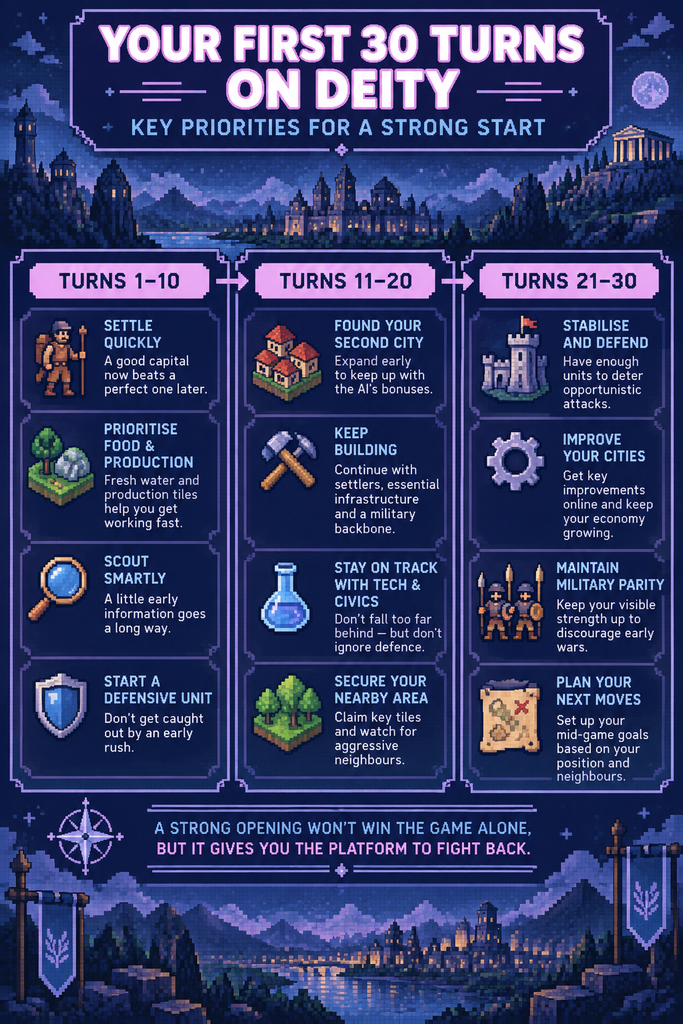
Settling speed matters more here than on any other difficulty. A turn or two lost scouting for a marginally better tile is a turn or two the AI spends compounding its production bonus, so a good capital settled fast usually beats a great capital settled slow.
Capital placement should prioritise fresh water and immediate production tiles over long-term optionality. You want your capital working from turn one, not turn five, because every early turn where your city sits idle is a turn the AI’s inflated yields pull further ahead. For a refresher on settling fundamentals and build order basics, Chill Place Gaming’s early game strategies guide covers the mechanics this piece assumes you already know.
Build order needs to skew defensive earlier than habit suggests. On Sovereign and below, you can often get away with beelining economic buildings and adding defenses reactively. On Immortal and Deity, that is how you lose a settler or an outer city to an early AI war party you never saw coming, so a couple of turns of early defensive infrastructure is rarely wasted.
Food and production tiles should generally win out over pure gold or culture tiles in your first few city work assignments. A capital that grows and produces quickly can pivot into whatever the game needs later, while a capital that chases early gold or culture output usually cannot catch up on the growth and production it skipped.
Your second city matters almost as much as your capital on high difficulty, and settling it later than turn eight or nine starts to cost you noticeably. The AI is not just out-producing individual cities, it is out-producing you on a per-civilisation basis, so adding city count early is one of the few levers you fully control.
A few adjustments consistently separate players who stabilise on Deity from players who do not:
- Scout aggressively but briefly, since map knowledge matters less than a fast, committed capital placement.
- Treat your second and third settlements as priorities, not afterthoughts, because city count partly offsets the AI’s per-city yield advantage.
- Keep at least one unit of quality defence up earlier than feels necessary, given the AI’s inflated combat strength.
- Watch independent power settlements closely in the opening eras, since their combat modifier is also difficulty-scaled and can punish careless exploration.
🗺️ Leader and Civ Picks Worth Building Around
Leader and civilisation choice matters more at high difficulty than it does at Sovereign, because a strong civilisation ability can partially offset the AI’s yield bonuses in a way that a middling one cannot. This guide will not re-run the full combo breakdown, since Chill Place Gaming’s leader and civilisation combinations guide already covers that ground in detail.
The short version for Immortal and Deity specifically is that picks offering early production, science or defensive resilience tend to hold up best, since they blunt the exact bonuses the AI is leaning on hardest in the first few eras. Civilisations that lean on late-game snowballing are harder to pilot on Deity, because you may not survive long enough for that snowball to start.

It is also worth resisting the urge to pick purely for a strong late-game ceiling. A leader combo that is merely solid but keeps you alive and stable through the opening thirty turns will outperform a spikier pick that leaves you exposed early, no matter how strong its late-game numbers look on paper.
Adaptability across ages matters more on Deity than raw power in any single age. Because the AI’s bonuses ramp with each era rather than staying flat, a civilisation that can pivot cleanly at age transitions tends to age better than one that peaks hard in the Antiquity age and then fades.
If you already have a favourite leader and civilisation from lower difficulty play, it is worth testing whether that combination still holds up before abandoning it for a tier list pick. Familiarity with a civilisation’s rhythms often closes more of the difficulty gap than switching to an unfamiliar combo purely because it ranks higher on paper.
⚠️ The Mistakes That Sink a Prince-to-Deity Jump
The single most common mistake is treating Deity like Prince or King with a harder difficulty label attached, rather than recognising it as a different strategic problem. Players carry over habits that worked fine against a passive, resource-poor AI and get punished the moment that AI has both the yields and the aggression to capitalise on any hesitation.
A second frequent error is racing the AI on tech or production in the early game. You will lose that race on Deity almost every time, so the goal in the opening eras is not to match the AI’s output but to build a foundation, in city count, defence and infrastructure, that lets you catch up once the difficulty curve flattens in the mid-game.
Underestimating early aggression is another common trap. Because the AI’s combat bonus is front-loaded and does not require it to out-produce you to field a threatening army, players who skip defensive investment in favour of pure economic growth are frequently punished by turn 30 or 40, long before they expected real danger.
Finally, many players jump straight from Sovereign to Deity and skip Immortal entirely. Immortal is a meaningfully smaller step up, and using it to test and refine a high-difficulty opening before adding Deity’s extra combat and yield bonuses on top will save a lot of frustrating, avoidable losses.
A related mistake is misreading the AI’s aggression signals because they no longer behave the way they did on lower difficulties. A neighbour who seems friendly on Sovereign can still turn on you quickly on Deity if your visible military strength dips, so treat any drop in relative strength as a prompt to check your defences rather than a purely cosmetic stat.
Overcommitting to a single win condition before the mid-game is another avoidable error. Locking in a science rush at turn ten, before you know whether the AI has a runaway science lead, often wastes the flexibility that separates a recoverable Deity game from an unrecoverable one.
🏆 Rethinking Victory Conditions When You’re Behind
On lower difficulties, victory planning is often a straight race: pick a condition, optimise for it, outpace the AI. On Deity, the AI frequently has a tech or resource lead by the midgame no matter how well you play the opening, so victory planning has to account for that lead rather than pretend it away.
Racing a science or culture victory against an AI with an 80% science or culture bonus is rarely the highest-percentage plan unless your opening was exceptionally strong. It is usually smarter to prioritise stabilising your economy and territory first, then pick a victory condition based on which AI civilisations are weakest in that lane, rather than committing early to whichever condition looked appealing at the start.
Military and diplomatic pressure become more valuable tools at high difficulty, not because domination is the only viable path, but because disrupting an AI’s economic lead, through war, blockade or diplomatic isolation, can matter more than out-teching it directly. For a deeper look at working with and around the AI’s resource advantages, Chill Place Gaming’s resource management guide is useful groundwork for this kind of mid-game pivot.
How that plays out differs by victory type, so it is worth thinking about each one separately rather than applying one rule to all of them:
- Science and culture victories are the hardest to force through a direct race, since they compete head-on with the AI’s biggest yield bonuses, so they work best when you can identify a specific AI rival who is clearly behind in that lane.
- Domination and military pressure scale well with difficulty, because disrupting an AI’s cities directly removes its yield advantage rather than trying to out-produce it.
- Economic and diplomatic paths reward patience, since they let you convert a stable, well-defended position into leverage over time instead of racing a clock the AI already has a head start on.
There are no guaranteed formulas here, and nothing in this section should be read as a shortcut. Deity victory planning is closer to triage than to a fixed build order: assess what the AI actually has by the mid-game, then commit to the path with the fewest obstacles rather than the one you originally wanted.
⚖️ Immortal or Deity: Which Should You Actually Be Playing
Deity gets treated as the default end goal in a lot of strategy content, but that framing does not suit everyone, and it is worth being honest about that. If your Immortal games are still inconsistent, spending more time there to build consistent habits will improve your Deity results far more than repeated, frustrating Deity losses will.
Consolidating on Immortal is a completely reasonable long-term choice, not a consolation prize. It offers a real, sustained challenge without the AI’s combat and yield bonuses reaching the point where a single early misstep is close to unrecoverable, which makes for a more consistent, less swingy experience across a full campaign.
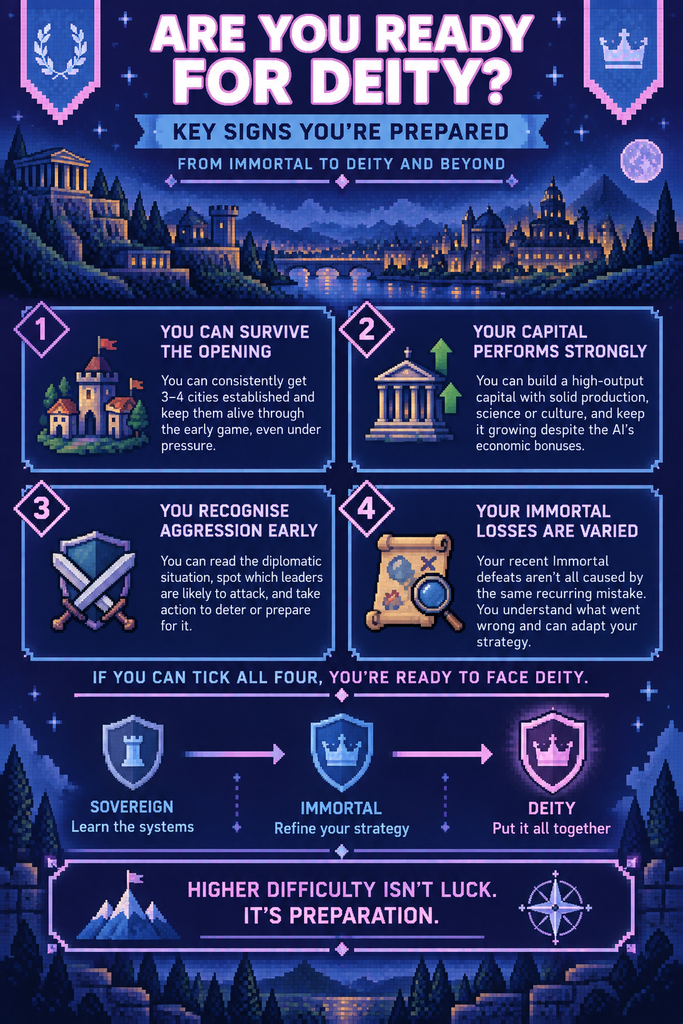
Push for Deity once you can reliably reach the mid-game on Immortal with your capital, defence and early expansion intact, since that consistency is the actual prerequisite, not a fixed number of hours played. Treat a first handful of Deity attempts as scouting missions for what the AI is capable of rather than as wins you are entitled to, and the eventual win will feel earned rather than lucky.
A few honest signals suggest you are ready to try Deity rather than simply due for another Immortal loss:
- You can settle three or four cities on Immortal without losing one to an early war.
- Your capital reaches a strong production or science output well before the AI visibly pulls ahead.
- You can read AI aggression signals early enough to reinforce a border before it becomes a crisis.
- Your last few Immortal losses came from bad luck or an unfamiliar map, not from a repeated strategic gap.
If most of those do not apply yet, that is useful information rather than a discouraging verdict. Chasing Deity before Immortal is genuinely consistent tends to produce more frustration than growth, and there is no ranking system here penalising you for taking the slower route.


