As an Amazon Associate I earn from qualifying purchases and sometimes recommend products from other sellers at no extra cost you. For more details see my disclosure policy and privacy policy.
You press start on a new Civilization VII game, the loading screen fades, and your Founder is standing on a hex that you did not choose. Within about a minute you will decide whether to found a capital right there, shuffle a tile or two, or quit and roll again. Most guides pick up the story after that choice, with build orders and policy picks for a city that already exists.
This post covers the choice itself. It gives you a short, repeatable way to judge a starting spot in the first few turns, whether the map was randomly generated or you are playing the Real Earth map. By the end you should know when to settle in place, when to move, and when a start is genuinely worth a restart.
🌱 What Makes a Start Good in Civ VII
A good start gives your capital room to grow and something useful to build with. In practice that comes down to four things: a balance of food and production, access to water, a few valuable resources, and terrain you can hold.
Food and production. Early growth drives almost everything else, so food comes first. Production is a close second, because a capital with no hills, forest or similar tiles will take forever to produce its first Settlers and buildings. You want both within reach, and a tile or two of each beats a lot of one and none of the other.
Chill Place Gaming Store
Take your game further 🎮
Reference sheets, printable guides, and gaming goodies — made by the Chill Place Gaming team to help you play smarter.
Secure checkout
powered by Shopify
Water. Fresh water matters for Happiness, and coast or a navigable river matters later for the Exploration Age. A capital does not need to sit on the coast, but you should know where the nearest usable coast is. If you want the mechanics of fresh water, our fresh water settlement guide covers them in detail, so I will not repeat them here.
Resources. Look for resources that match what you plan to do. The best early picks are the ones that speed up growth or production, followed by the ones that feed your intended Legacy Path. Our resource management guide explains which types are worth chasing.
Defensible terrain. Rough terrain, rivers and chokepoints make a capital harder to attack and easier to defend with fewer units. Rough tiles also stop movement, which cuts both ways when your own units need to get out. For a relaxed game against the AI this is a tiebreaker, not a priority, but it matters more on crowded maps.
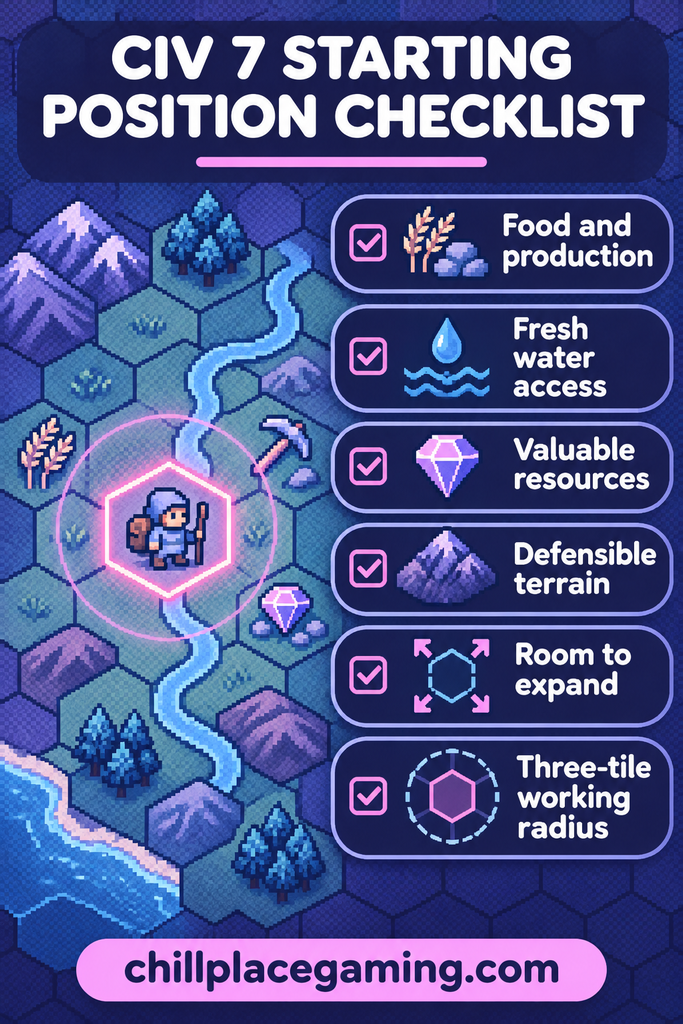
One limit shapes everything below. Settlements can generally only claim hexes up to three tiles from the city centre, so what you can see around the Founder is most of what that capital will ever work.
✅ The First-Turns Start Checklist
Here is the routine I run before founding a capital. It takes a couple of minutes and keeps me from settling on autopilot.
- Turn on the helpful lenses. Open the lens menu above the minimap and switch on yields, resources and the Settler View. The Settler View shades places you cannot settle red and good places green, and hovering over a marker usually tells you why a spot scores well.
- Count what sits inside three tiles. List the food, production and resource tiles you can see in that radius. The Radial Ruler overlay, added in update 1.5.0, shows three and six tile rings, which makes this much quicker.
- Check the water. Is there a river, lake or coast within a tile or two? Remember that a lake beside you is not the same as coast.
- Look at the terrain around you. Note hills, forests, mountains and any floodplain or volcano warnings the lens shows. Those can add yields, but they can also damage buildings.
- Scout one tile at a time. The Founder reveals very little as it moves. Community testing suggests it has about three movement points and stops on entering rough or vegetated terrain, so step carefully and keep a point back for founding.
- Decide what the capital must do. Is it a wonder city, a production anchor, or a quiet science base? A clear job makes the trade-offs much easier.
- Make the call. If nothing nearby is clearly better, found the capital where you stand.
That last point is the most important. Founding on the first turn has real value, and most starts are fine.
🎲 Reading a Randomly Generated Map
On a random map, the first thing to understand is how it was built. The current default for single player is Continents and Islands, which uses Voronoi-based generation, and update 1.5.0 added Shuffle and Terra Incognita maps. Terra Incognita guarantees that one region is Continents-style and puts human players on that side when it can.
The generation rules also keep Homelands and Distant Lands separated by deep ocean, so you will not walk to every landmass. I could not find any official description of how starting locations are chosen or balanced, so I would treat any claim about hidden start bias with caution. Judge what you can see rather than what you assume.
Good signs:
- A mix of food and production tiles within three hexes
- Water close by, with a river or coast to build around
- At least one or two resources that suit your plans
- Room to place a second and third settlement without crowding a neighbour
Red flags:
- A cluster of desert, tundra or bare terrain with few resources
- No fresh water and no coast anywhere in sight
- A neighbour whose territory touches your three-tile ring
- A start squeezed onto a very small landmass
A small island start is not automatically bad. Islands are now land of up to 30 connected tiles, and update 1.5.0 added a plot tooltip that tells you whether a tile is part of one. Check that before you decide a cramped coast is a dead end.
If you are new to how towns and cities differ, our cities versus towns guide is a good companion read.
🌍 Real Earth Starts
The Real Earth option is the True Start Location (TSL) Earth map, introduced in update 1.5.0. It is Huge only, and each civilization starts near its historic capital. All campaigns begin in Antiquity, and Advanced Starts are not supported.
Because the start is tied to history, you judge it differently. You are not asking whether the game gave you a good tile. You are asking what this real place offers, and how to play to it.
Read the geography. Ask the same checklist questions, then add a few of your own. Is your region crowded with neighbours, or does it have open land? Is there a major navigable river nearby? Is it a coast, an inland plain, or an island?
Expect some help from the map. The mapmakers enlarged Europe, Hawaii and Japan, and trimmed tundra and empty ocean, so island and crowded starts are less punishing. Resources on this map are hand placed to reflect real places, and every resource appears in every game. Seven Natural Wonders are drawn from a pool each game and appear in their matching regions.
Plan around the weak spots. If your region is crowded, expect early contact and think about defence. If you sit on an island, plan for early naval access. If you are inland, lean on rivers and wait for trade routes.
Two rules are worth knowing. If civilizations would start within three tiles of each other, the game moves AI players to unused spots, but a human in a single-player game is never moved. The three landmasses are the Americas, Africa and Eurasia, and Oceania, and they stay Distant Lands to one another until the Exploration Age.
I am not going to rank civilizations by start quality here. The map is new enough that I would rather you test your own region than trust a list.
🎭 Matching the Start to Your Leader and Civ
A start is only good or bad relative to a plan. A civilization with strong river or coastal bonuses wants water, while one built around production or wonders wants hills and rough terrain.
On a random map you can often pick your pairing to suit the start, or at least adjust your plan once you see it. Our leader and civ combinations guide is the place to look for pairings that fit each victory type.
On a Real Earth map the order flips. Your civ chooses the location, so you play to what the location gives you. Your position is also tied to your starting civilization, even if you evolve into a different one at an Age Transition.
Time-Tested civs add another option. You can start as any civ in any Age and choose at each Age Transition whether to stay or swap, so a mismatch between civ and terrain does not have to last the whole game.
🔄 When to Move, Settle in Place, or Restart
Here is the decision rule I use.
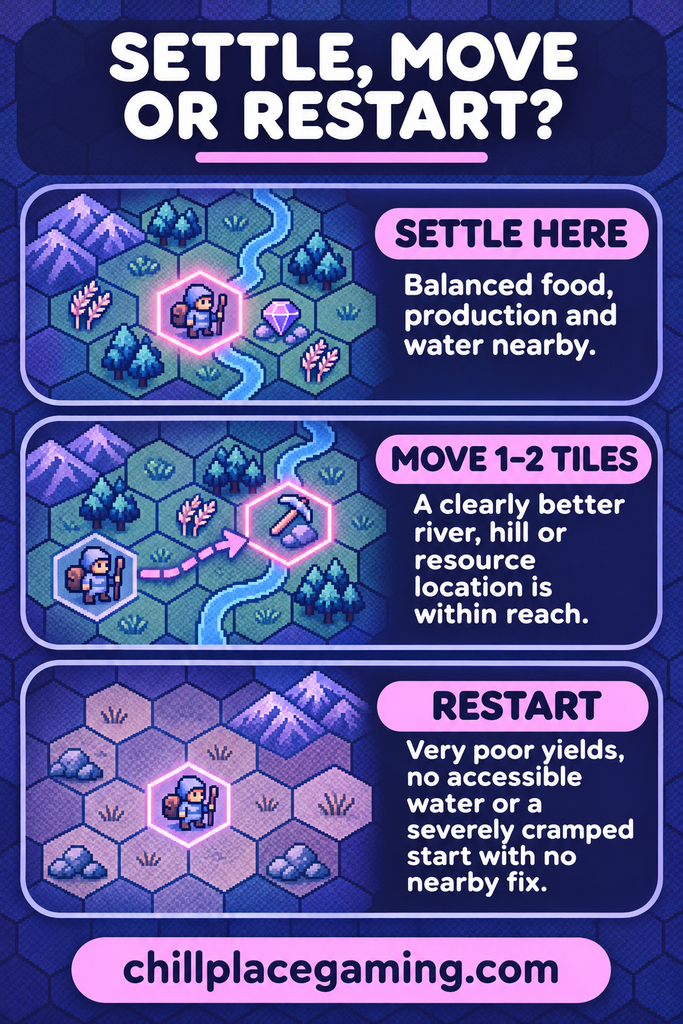
Settle in place when the start is decent or merely average. If you can name food, production and a water source within the ring, you are fine. A turn spent wandering costs more than a slightly imperfect capital.
Move one or two tiles when a clearly better site is visible nearby. Good reasons include a river just out of reach, a key resource just outside the ring, or a hill that would anchor the city. Do not move for a vague feeling, and remember that you lose sight of the tiles you started beside.
Restart when the problems are structural and you can see them at once. That means no water, almost no food or production, or a landmass that is clearly too small, and nothing within a move or two fixes it. Restarting costs a few minutes. Playing a doomed capital for two hours costs far more.
One more thing helps. Discoveries on the map can be destroyed if you walk onto them with the Founder, so check what you are stepping on before you commit.
For relaxed play, I would add a personal rule. If you feel nagging doubt after the checklist, decide once and move on. A good plan on a mediocre start beats an endless search for a perfect one.
⏭️ How Your Start Affects Ages and Distant Lands
The start matters beyond the opening. Your capital carries through Age Transitions, while other cities fall back to settlement status at the transition, so your first site tends to anchor the whole game. Our Age Transition guide walks through the reset in more detail.
Coast or a navigable river becomes much more important in the Exploration Age. Treasure resources sit in the Distant Lands, and reaching them usually means a coastal or river-connected settlement. If your capital is inland, plan early for a port or a second city on the water.
Think about where your next settlements will go while you judge the first one. A start with space for a coastal second city gives you options later. A start boxed in by neighbours or mountains may ask you to plan for the Distant Lands sooner.
For a wider look at what recent updates changed, our Test of Time update breakdown covers the bigger picture.
📚 Continue Your Journey
Judging a start comes down to a handful of questions asked in the same order each time. Look inside three tiles, find water, check resources and terrain, and make a call. Most of the time you will settle in place and get on with building.
If you are still learning the opening, our early game strategies guide picks up where this one ends. Fresh to the game itself? You can pick up a copy of Civilization VII and put the checklist to work on your next map. Then come back and tell us which start you nearly restarted for.