
As an Amazon Associate I earn from qualifying purchases and sometimes recommend products from other sellers at no extra cost you. For more details see my disclosure policy and privacy policy.
There’s a particular kind of exhaustion that only strategy game players understand. You’ve spent three hours rerouting train lines in Factorio, your city in Cities: Skylines II is drowning in traffic, and your Civilization VII empire is one bad diplomatic roll away from collapsing. The game you love is starting to feel like unpaid work.
This is strategy burnout — and it’s real. The solution isn’t to quit gaming entirely. It’s to find games that scratch the same planning and optimisation itch without the punishing failure states. Every game on this list is strategically interesting, genuinely rewarding to optimise, and specifically designed to let you breathe.
🧠 What Makes a Strategy Game Relaxing?
Before the picks, it’s worth being clear about what we mean. This isn’t a list of idle clickers or pure sandbox toys. These are games with real systems, real decisions, and real depth. The difference is in how they handle failure.
Relaxing strategy games tend to share a few traits:
Chill Place Gaming Store
Take your game further 🎮
Reference sheets, printable guides, and gaming goodies — made by the Chill Place Gaming team to help you play smarter.
Secure checkout
powered by Shopify
- Gentle or no fail states — economies recover, mistakes aren’t permanent
- Slower pacing with focused, manageable goals
- Soothing aesthetics and soundtracks that reward time spent
- Systems complex enough to keep your brain engaged, without demanding perfection
Every pick below also includes an “advanced but chill” way to play, for when you want more depth without adding stress. Think of these as your palette-cleansers between the heavy sessions.
🏙️ Game Picks
1. Against the Storm — A Roguelike City-Builder That Resets the Pressure
Against the Storm might be the most elegant answer to strategy burnout that exists. You’re building small settlements in a dark fantasy world, managing resources, keeping villagers happy, and completing objectives before the storm arrives. Then the run ends — win or lose — and you start fresh.
That reset structure is what makes it work. Nothing carries over except your meta-progression, which means every mistake is a lesson rather than a catastrophe. The strategy is genuinely rich: you’re balancing different species with different needs, juggling production chains, and making real trade-offs. But the stakes per session feel completely manageable.
Advanced but chill: Chase the Prestige difficulty tiers once you’re comfortable, or challenge yourself to complete runs using only specific species combinations. The depth is there when you want it, invisible when you don’t.
You can read the full Against the Storm review if you want a deeper breakdown of what makes it tick.
2. Anno 1800 — Slow-Burn Industrial City-Building at Its Best
Anno 1800 is a masterclass in production chains, and it’s one of the few city-builders where you can genuinely lose yourself in the aesthetics as much as the systems. You’re building a 19th-century harbour city, managing supply routes, trading with other islands, and slowly expanding an industrial empire. The pace is deliberate by design.
The game has no punishing real-time combat to worry about (unless you specifically engage with it), and the economy is forgiving enough that early mistakes can be corrected with patience. This is a game you play with a cup of tea and no particular rush to get anywhere.
Advanced but chill: Focus on maximising the happiness of your top-tier residents, which requires incredibly complex supply chains, without worrying about maximising money or map control. Pure optimisation for its own sake, at your own pace.
3. RimWorld — Colony Management Chaos That’s Actually Chill
RimWorld has a reputation as a brutal survival game, and in some modes, it earns it. But the storyteller AI options change everything. Play on Peaceful or Chill storyteller difficulty and you get a genuinely warm, story-driven colony simulator where disasters are rare and your colonists have space to develop personalities, relationships, and skills.
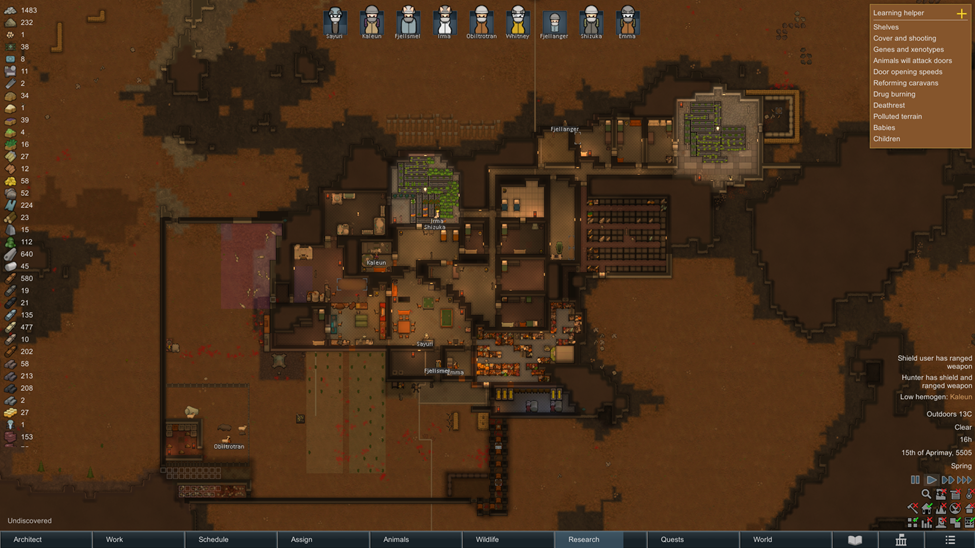
The depth here is extraordinary — you’re managing work priorities, food production, crafting, trade, and mental health simultaneously. But when the pressure is dialled back, it becomes something closer to a slow-burn narrative game. You build a base, you tell a story, and you watch your little community grow.
Advanced but chill: Set arbitrary rules for yourself — a vegetarian colony, a pacifist run, a colony that never trades with outsiders. Self-imposed constraints add complexity without adding stress.
If you want to understand the colony-sim side of things before jumping in, the Beginner’s Guide to Simulation Games covers the core loops well.
4. Worshippers of Cthulhu — The Cult City-Builder You Didn’t Know You Needed
Worshippers of Cthulhu is genuinely surprising. On the surface it sounds stressful — you’re managing a cult, appeasing an elder god, and keeping followers from losing their minds. In practice, it’s a deeply satisfying city-builder with a forgiving economy and a genuinely fresh take on settlement management.
The strategy centres on balancing faith, resource production, and your followers’ growing cosmic awareness. Fail states exist, but the game is generous with time and resources, giving you space to course-correct. The visual aesthetic is eerie but stylish, and the systems are inventive enough to feel fresh if you’ve played a lot of standard city-builders.
Advanced but chill: Try to maximise cult efficiency while keeping corruption at zero — a genuine optimisation challenge that doesn’t punish you for slow progress.
5. Crusader Kings III — Grand Strategy That Plays Like a Story Generator
Crusader Kings III is technically one of the more complex games on this list, but it earns its place here because of how the stress manifests. You’re not managing real-time battles or optimising production queues. You’re making decisions about marriages, succession, plots, and relationships — and then watching history unfold.
The depth is enormous, but most of it is optional. You can play a small county, focus on family drama, and almost entirely ignore the military expansion side of things. The game rewards engagement with its systems, but it doesn’t punish you for ignoring the ones you don’t enjoy.
Advanced but chill: Pick a tiny, landlocked county and focus purely on building the most stable dynasty possible through diplomacy and careful marriages. No conquest, no war — just political chess.
6. Slime Rancher — Resource Management With All the Edges Sanded Off
Slime Rancher is probably the warmest game on this list. You’re managing a ranch full of adorable creatures called slimes, collecting resources, expanding your operation, and exploring a colourful alien world. The management systems are genuinely interesting — you’re balancing slime diets, preventing crossbreeding, managing silo storage, and optimising your economy.

But the presentation is relentlessly cheerful, the stakes are low, and the exploration is gentle and rewarding. This is the game you play when you want your brain to work without your body tensing up.
Advanced but chill: Work towards building a perfectly organised, maximally efficient ranch from scratch — no chaos, no improvisation. The optimisation potential is deeper than it looks.
7. Civilization VII — Turn-Based Strategy on Your Own Schedule
Wait — wasn’t Civ VII one of the games causing burnout? It can be, but it doesn’t have to be. The turn-based format is key: nothing happens unless you decide it happens. You can pause, walk away, think for as long as you want, and return exactly where you left off.
Play on Prince difficulty or below, choose a leader you find interesting rather than one that’s meta-optimal, and focus on a single victory type you enjoy. The game becomes a slow-building empire story rather than an efficiency race. The strategy is still deep and rewarding — you’re still mastering leader and civilisation combinations and thinking through long-term planning — but the urgency disappears entirely.

Advanced but chill: Attempt a culture victory without looking up which leaders are rated best for it. Pick based on theme, not stats, and see how creative your approach has to be.
8. Townscaper — Pure Building, Zero Pressure
Townscaper is the game on this list with the least strategy and the most peace. You click to place coloured blocks, and the game automatically generates beautiful architecture: bridges, arches, towers, courtyards, hanging gardens. There are no resources, no citizens to manage, no failure conditions.
What makes it relevant here is that it’s a genuine creative outlet for the planning and spatial reasoning that strategy gamers love. You’re making aesthetic decisions constantly — colour choices, height variations, island shapes — and the results are consistently beautiful. It’s the gaming equivalent of doodling.
Advanced but chill: Challenge yourself to recreate a real-world city district or architectural style from scratch. You’d be surprised how complex the problem becomes.
9. Slay the Spire — Deckbuilding Strategy in Bite-Sized Sessions
Slay the Spire is turn-based, contained, and completable in sessions of any length. You’re building a card deck run by run, making strategic decisions about which cards to take, which relics to prioritise, and which enemies to engage with. The runs are short enough to feel low-commitment, but the depth is vast.
The roguelike structure means every run is independent — no long-term save to maintain, no sprawling empire to manage. If a run goes badly, you simply start again with new possibilities. The game rewards pattern recognition and long-term thinking without ever demanding hours of continuous play.
Advanced but chill: Attempt off-meta deck archetypes — builds based around a single unusual synergy rather than the strongest cards available. The constraint forces creative solutions.
10. Little Big Workshop — Management Sim With Charm to Spare
Little Big Workshop puts you in charge of a tiny workshop that grows from a single workbench into a sprawling miniature factory. You’re managing production queues, worker assignments, machine purchases, and customer orders — all through the lens of a charming miniature-world aesthetic that makes everything feel low-stakes.
The resource management principles that apply to heavier strategy games are all here, but wrapped in visuals that feel approachable rather than overwhelming. It’s a genuine introduction to production-chain thinking for players who want a lighter entry point, and a satisfying puzzle for veterans who want to optimise without pressure.
Advanced but chill: Set yourself a challenge run: only accept the highest-tier contracts, build a workshop specialised in a single product category, and max out every efficiency rating before the campaign ends.
🎮 How to Pick the Right Relaxing Strategy Game for Your Mood
The choice often comes down to what’s causing the burnout in the first place.
If the problem is complexity and too many moving parts, Townscaper or Slay the Spire are your best entry points. Both are self-contained and forgiving, and they’ll let your brain decompress while staying active.
If the problem is punishing failure states, Against the Storm or Little Big Workshop remove the sting almost entirely. Mistakes in both games are recoverable, and neither will punish hours of progress with a single bad decision.
If you want depth without urgency, Civilization VII on lower difficulties or Crusader Kings III with a small starting territory give you all the strategic richness with none of the pressure. Understanding the difference between turn-based and real-time strategy is worth considering here — the slower formats are almost always more forgiving by design.
If you love city-building specifically, Anno 1800 and Against the Storm are the strongest picks. Both reward planning and optimisation while giving you time to breathe.
A useful habit: rotate one relaxed game alongside your main heavy hitter. An hour in Slime Rancher after a punishing Factorio session does something genuinely useful for your ability to return to the harder game refreshed rather than depleted.
⏭️ It’s Okay to Downshift
Strategy gaming is supposed to be fun. The moment it starts feeling like a second job, something has gone wrong — and the solution is rarely to push through.
Every game on this list will exercise the same parts of your brain that love Factorio and Cities: Skylines II. The planning, the optimisation, the satisfaction of a system running smoothly. They just do it without the grinding punishment, the punishing failure cascades, or the sense that you’re always one bad decision away from starting over.
Your harder games will still be there when you’re ready for them. And you’ll probably find you approach them better after a week of letting your guard down.
What do you reach for when strategy burnout hits? Drop your go-to in the comments — I’m always looking for new recommendations.
Continue Your Journey
- Against the Storm Review: Where City-Building Meets Strategic Roguelike Innovation — A deep look at why this roguelike city-builder has become essential for the genre
- The Complete Beginner’s Guide to Simulation Games — New to management sims? Start here
- Best Cozy Games to Play During Winter — More low-pressure game recommendations for unwinding
- Turn-Based vs Real-Time Strategy Games: Which One Suits You Best? — Understanding the pacing differences that make or break a session
- Micro vs Macro Management in Strategy Games: Finding Your Balance — Useful context for why some strategy games feel exhausting and others don’t
Want more strategy game guides and weekly roundups? Subscribe to the Chill Place Gaming newsletter for fresh content every week.


