As an Amazon Associate I earn from qualifying purchases and sometimes recommend products from other sellers at no extra cost you. For more details see my disclosure policy and privacy policy.
The Civilization franchise has defined the 4X strategy genre for decades, challenging players to guide their chosen culture from humble beginnings to global dominance. With Civilization VII’s recent release, longtime fans and newcomers alike face an important decision: stick with the polished, content-rich experience of Civilization VI, or embrace the bold new direction of its successor?
Both games offer distinct approaches to empire building, but VII represents the most significant departure from series traditions in years. The changes touch everything from how cities grow to how civilizations themselves evolve throughout history. Understanding these differences helps determine which version aligns with your strategic preferences.
Revolutionary Changes in Core Gameplay
The Three-Age System: A New Pace of History
Civilization VI follows the traditional model with multiple historical eras spanning from Ancient times through the Information Age. Players experience gradual technological progression with familiar pacing that allows for long-term strategic planning.
Civilization VII streamlines history into three distinct ages: Antiquity, Discovery, and Modern. Each age transition brings dramatic changes and forces civilizations to evolve. This creates a more structured experience where players must adapt their strategies as ages progress, rather than maintaining the same approach throughout the entire game.
Chill Place Gaming Store
Take your game further 🎮
Reference sheets, printable guides, and gaming goodies — made by the Chill Place Gaming team to help you play smarter.
Secure checkout
powered by Shopify
The turn limits between ages mean games move faster than VI’s potentially endless sessions. You can’t remove these time constraints, which fundamentally changes how you approach long-term planning. Strategic decisions carry more weight when you know exactly how much time remains in each historical period.
Civilization Evolution: From Static to Dynamic Cultures
The most radical change in VII is civilization transformation. Civilization VI locks you into your chosen leader and civilization for the entire game, encouraging deep specialization with specific bonuses and units.
Civilization VII allows civilizations to evolve between ages based on your choices and circumstances. A Roman empire might become the Byzantine Empire in the Discovery Age, then transform into Italy in the Modern era. This system dramatically increases replayability since the same starting civilization can lead to completely different endgame experiences.
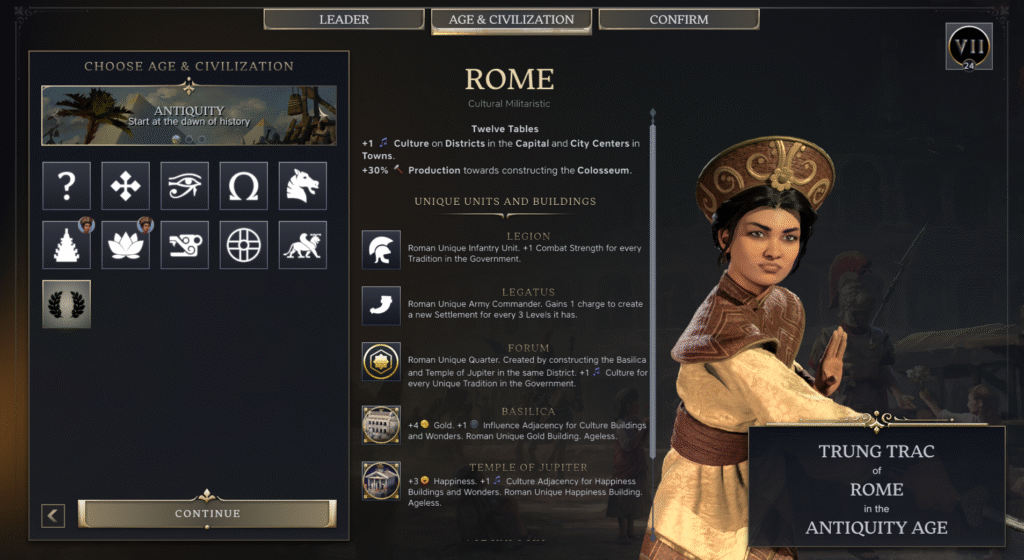
The leader system also gains flexibility. Leaders can guide different civilizations throughout history, creating unique combinations that weren’t possible in VI. This separation of leaders from specific cultures opens up fascinating strategic possibilities.
City Management: From Micromanagement to Strategic Direction
Civilization VI requires hands-on city management with builder units manually constructing improvements. Players must carefully consider tile improvements, district placement, and city specialization through detailed micromanagement.
Civilization VII automates many city development tasks while giving players strategic control over expansion direction. You can directly influence where cities grow and how buildings are arranged, but the game handles basic improvements automatically when cities expand. This shift emphasizes high-level strategic decisions over tedious micromanagement.
The introduction of towns adds another layer to territorial control. Towns serve as smaller settlements that can eventually upgrade to full cities, but mastering when and where to make these upgrades requires understanding the new economic systems. Gold plays a more central role since you need it to purchase buildings and units in towns, making economic planning more crucial than in VI.
Military Revolution: Commanders Over Individual Units
Civilization VI focuses on individual unit management with experience systems and promotion trees for each military unit. Combat involves positioning multiple units and managing their specific abilities and upgrades.
Civilization VII introduces commander units with unique abilities and upgrade trees, shifting focus from individual unit micromanagement to army composition and strategic leadership. Commanders provide bonuses to nearby units and unlock special abilities that can turn the tide of battle.
This system reduces the tedium of managing dozens of individual units in the late game while maintaining tactical depth through commander abilities and positioning. The change makes military campaigns feel more like commanding armies rather than managing individual soldiers.
Streamlined Diplomacy and Independent Peoples
Civilization VI separates barbarians and city-states into distinct systems with different interaction methods and diplomatic options.
Civilization VII combines these concepts into “Independent Peoples” with more dynamic diplomacy options. These groups can be negotiated with, allied with, or absorbed into your empire through various means. The system creates more organic relationships with non-player civilizations and removes the sometimes arbitrary distinction between different independent groups.
Visual and Technical Evolution
Graphics and Presentation
Civilization VII features more detailed and vibrant visuals with improved animations and map clarity. The new art style provides a fresh take on the series’ visual identity with enhanced environmental details and unit animations.
However, some players find certain UI elements less readable than VI’s clean interface. Unit health indicators and technology trees occasionally lack the immediate clarity that made VI so accessible. The modernized menus offer improved functionality, but the learning curve for existing players can be steeper than expected.
Performance and AI Improvements
Civilization VII delivers faster turn times and improved late-game performance, addressing one of VI’s persistent challenges. The AI demonstrates more nuanced behavior in both combat and diplomacy, creating more engaging and unpredictable opponents.
The smarter AI makes meaningful strategic decisions rather than simply following predictable patterns. Diplomatic interactions feel more natural, and military AI poses genuine tactical challenges rather than relying solely on numerical advantages.
Strategic Depth and Player Agency
Economic Systems
Civilization VI emphasizes diverse economic strategies through district specialization and trade route management. Players can focus on specific economic approaches like commercial hub networks or campus-driven science victories.
Civilization VII places greater emphasis on gold as a central resource. The need to purchase buildings and units in towns creates new economic pressures and strategic decisions. Resource management feels more immediate and consequential, especially during age transitions when civilizations undergo major changes.
Victory Conditions and Replayability
Civilization VI offers well-established victory paths with extensive DLC content providing numerous leaders, civilizations, and scenarios. The mature ecosystem includes refined balance and diverse strategic options developed over years of updates.
Civilization VII launches with fewer civilizations and leaders but promises significant expansion potential. The civilization evolution system creates multiple paths from the same starting point, potentially offering higher replayability despite the smaller initial roster.
The age system forces players to adapt their victory strategies as the game progresses, preventing the single-focus approaches that sometimes dominated VI campaigns. Each age offers new opportunities and challenges that require strategic flexibility.
Community Reception and Critical Analysis
Civilization VI Strengths
The established player base appreciates VI’s polished systems and extensive content library. Years of updates have refined the balance and added substantial variety through DLC releases. The game offers a mature, feature-rich experience with proven gameplay systems.
The micromanagement elements that some find tedious, others value for the control and optimization opportunities they provide. Builder units and detailed city planning appeal to players who enjoy fine-tuning their empire’s development.
Civilization VII Innovation vs. Simplification
VII’s reception reflects the gaming community’s divided response to significant changes. Players praise the bold new direction and streamlined systems that reduce busywork while maintaining strategic depth. The civilization evolution system particularly resonates with those seeking fresh experiences.
Critics point to reduced complexity in certain areas and question whether the streamlined approach sacrifices too much depth for accessibility. Some longtime fans prefer VI’s proven formula over VII’s experimental new systems.
The UI readability concerns and smaller launch content library also factor into mixed reactions. While innovation is appreciated, execution in certain areas leaves room for improvement.
| System Category | Civilization VI | Civilization VII |
|---|---|---|
| Historical Progression |
Multiple eras (Ancient → Information Age)Medium
Flexible pacing, can extend games indefinitely for perfect strategy execution
|
Three structured ages (Antiquity → Discovery → Modern)Streamlined
Fixed turn limits create urgency and faster-paced strategic decisions
|
| Civilization Identity |
Static leader + civilization pairingSimple
Deep specialization with consistent bonuses throughout entire game
|
Dynamic civilization evolution between agesComplex
Massive replayability with same starting civ leading to different endgames
|
| City Development |
Manual builder units + district placementMicromanage
Complete control over improvements but requires constant attention
|
Automatic improvements + strategic building placementStrategic
Focus on expansion direction and building choices rather than tile-by-tile management
|
| Military System |
Individual unit experience + promotionsDetailed
Each unit becomes unique but late-game management can be overwhelming
|
Commander units + army compositionOrganized
Tactical depth through leadership without micromanaging dozens of individual units
|
| Economic Focus |
District specialization + diverse resourcesBalanced
Multiple viable economic strategies with district synergies
|
Gold-centric with town/city purchasingFocused
Gold becomes critical for town development and military expansion
|
| Independent Groups |
Separate barbarians + city-statesDistinct
Different interaction systems for different group types
|
Unified “Independent Peoples” systemStreamlined
More organic diplomacy with consistent interaction methods
|
| Territory Management |
City borders + district placementTraditional
Familiar expansion with planned district positioning
|
Towns + city upgrades + strategic building placementLayered
More granular territorial control but requires understanding town economics
|
| Game Pacing |
Player-controlled lengthFlexible
Can optimize and perfect strategies without time pressure
|
Structured age transitionsGuided
Forces adaptation and prevents single-strategy dominance
|
Making Your Strategic Choice
Choose Civilization VI If You Value:
• Extensive content variety with numerous DLC civilizations and scenarios • Detailed micromanagement and granular control over empire development • Proven gameplay systems refined over years of updates and patches • Traditional Civilization pacing with flexible game length and era progression • Established multiplayer community with known strategies and meta-game
Choose Civilization VII If You Prefer:
• Streamlined empire management with reduced micromanagement busywork • Dynamic civilization evolution that changes your strategic options over time • Faster-paced games with structured age transitions and turn limits • Modern performance improvements with better AI and technical optimization • Fresh strategic challenges that require adapting to new systems and mechanics
The Strategic Verdict
Both games serve different player preferences within the Civilization framework. VI offers the complete, polished experience that series veterans expect, with deep systems and extensive content accumulated over years of development.
VII represents a bold evolution that streamlines some systems while adding innovative mechanics like civilization transformation. The reduced micromanagement and improved performance appeal to players seeking a more focused strategic experience.
The choice ultimately depends on whether you prefer the proven depth of VI or the innovative potential of VII. Strategy enthusiasts who enjoy mastering complex systems might gravitate toward VI’s established mechanics, while those seeking fresh challenges and streamlined gameplay will find VII’s new approach compelling.
For newcomers to the series, VII’s more accessible systems and reduced micromanagement provide an excellent entry point. Veteran players must weigh their attachment to familiar systems against the appeal of genuinely new strategic challenges.
The civilization evolution system alone makes VII worth experiencing for its unique take on historical progression. Whether it replaces VI in your strategy game rotation depends on how much you value innovation over the comfort of proven gameplay systems.