
As an Amazon Associate I earn from qualifying purchases and sometimes recommend products from other sellers at no extra cost you. For more details see my disclosure policy and privacy policy.
You have a working factory. The green circuits flow, the oil is behind you, and somewhere on the horizon sits a rocket silo that looks more like a second job than a goal. If the thought of launching it makes you want to lie down, you are in good company.
The Factorio endgame does not have to be a sprint. Treat it as a series of small, finishable projects and the launch becomes the calm payoff of a factory you already like.
This guide covers what “winning” means in the base game, what the rocket actually needs, how to prepare, where launches stall, and how to decide when you are done. It sticks to the base game only; Space Age gets its own treatment elsewhere.
🚀 What Winning Actually Means in Base Factorio
The victory condition is simple: launch a rocket with a payload into space. That first launch triggers the victory screen, which thanks you and offers three choices: exit, view the credits, or carry on playing. You lose nothing by continuing, and your factory keeps running exactly as you left it.
Chill Place Gaming Store
Take your game further 🎮
Reference sheets, printable guides, and gaming goodies — made by the Chill Place Gaming team to help you play smarter.
Secure checkout
powered by Shopify
This matters for your mindset. Victory is not a cliff edge where the game ends and your base is taken away. It is a milestone, and you decide what comes after.
The payload detail is worth knowing. According to the Factorio wiki, a payload has been required to win since version 2.0.7, so an empty rocket will not do. In the base game, the standard payload is a satellite.
The reward for a satellite launch is 1,000 space science packs, delivered to a cargo landing pad. Those packs are the only way to get space science, as the pack cannot be crafted directly. They feed the infinite technologies, such as mining productivity, which is where long-term play lives.
So there are really two goals tangled together. One is “I launched a rocket”, which is the story ending. The other is “I want a steady supply of space science”, which is the open-ended factory goal.
🧭 Decide What “Done” Looks Like Before You Start
Before you place a single silo, choose your stopping point. It sounds small, but it is the single best defence against burnout. A goal with an edge is a goal you can finish.
Here are three honest finish lines:
- One launch, then credits. You build the silo, send one satellite, enjoy the victory screen and close the save with a clear conscience.
- A handful of launches. You launch a few times to bank some space science, spend it on a few infinite upgrades, then call it.
- A rolling launch loop. You want the factory to keep producing space science, because watching it hum is the fun part.
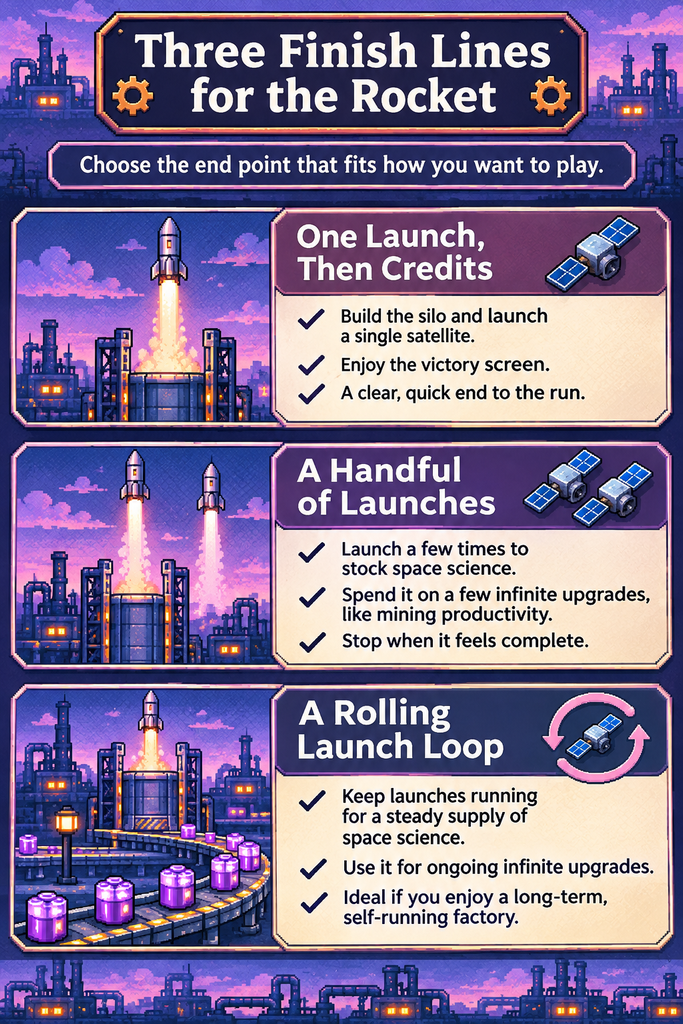
None of these is the “correct” one. If you are playing after work with a cup of tea, the first option is a perfectly good ending. Your save file will not judge you.
Write your choice on a sticky note or in a notes file. When motivation dips mid-build, that note reminds you what you are actually aiming for.
📋 What the Rocket Really Costs
The numbers are bigger than anything you have built so far, so it helps to see them laid out. All figures below come from the Factorio wiki and apply to the base game, so check the game’s own tooltips if you are on a different version.
The rocket silo is unlocked by the rocket silo research, which needs every science pack except military. The silo itself is built in an assembling machine and takes 1,000 concrete, 200 electric engine units, 100 pipes, 200 processing units and 1,000 steel plate. It draws 4 MW while running.
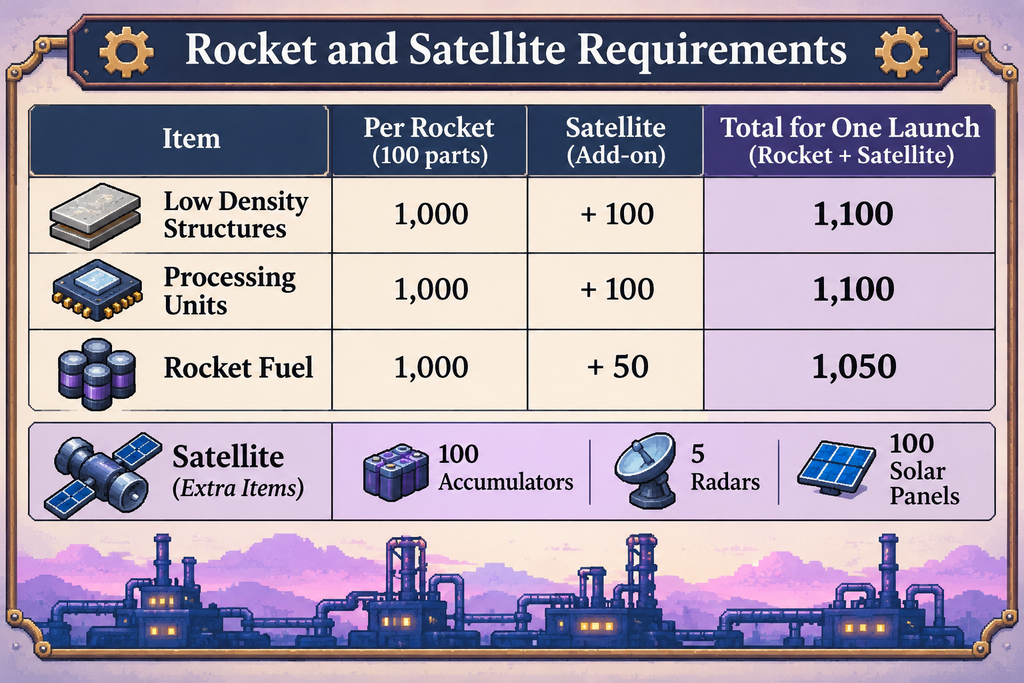
Each rocket part needs 10 low density structures, 10 rocket fuel and 10 processing units. A full rocket needs 100 parts, which works out to 1,000 of each ingredient. The satellite adds more: 100 accumulators, 100 low density structures, 100 processing units, 5 radars, 50 rocket fuel and 100 solar panels.
Add it up and a single launch swallows roughly 1,100 low density structures, 1,100 processing units and 1,050 rocket fuel. That sounds enormous, and it is, but remember that it is a one-off quantity per launch, not a per-minute demand. You can build up stock slowly over several evenings.
You will also want a cargo landing pad, which the wiki says requires the rocket silo research and can be crafted from concrete, steel and processing units. Only one can be placed on the surface, and it is where your space science arrives. The wiki describes it as the destination for those packs, so build it before your first launch rather than after.
📦 Get Ready: Buffers, Power and Logistics
Preparation is where most endgame stress gets defused. You are not trying to make the rocket parts quickly. You are trying to make them reliably, without you standing over the machines.
Build buffers, not a perfect main bus
Rocket parts are a stock-and-build job. A few chests of low density structures, processing units and rocket fuel, filled slowly in the background, take the pressure off completely. If a supply line hiccups, the buffer absorbs it.
Chests are your friend here. Put a chest between each intermediate product and the silo, and let it fill while you work on something else. You are trading space for calm, and space is cheap in Factorio.
Check your power before you need it
The silo draws 4 MW while it is working, and the assemblers making low density structures and processing units draw plenty more. Look at your production stats and check that your power graph has headroom well beyond what you use today.
Brownouts at launch time are the kind of problem that is annoying to diagnose and easy to prevent. If you are close to your limit, add generation now, while nothing is on fire. Solar and accumulators suit the relaxed approach, since they need no fuel logistics.
Decide how materials will arrive
You have two broad choices. Belts into a compact silo build work well if you like tidy lines, and robots work well if you would rather request items and let the network deliver them.
If you have not set up a bot network yet, our guide to using logistic robots and building logistic networks covers the basics. For many players, a requester chest per ingredient beside the silo is the lowest-effort route. You tell it what to hold, and the robots do the hauling.
Whichever you pick, keep the build near your main production if you can. Long supply lines are where small problems become evening-eating problems.
Keep an eye on defence
A quiet factory can get unquiet when pollution drifts toward new nests. The silo area is large, and a neglected corner is where biter attacks tend to start. If you have not looked at your perimeter recently, factory defence with biters, walls and turrets is a good refresher before you commit to a big new build.
🧱 The Bottlenecks That Stall Launches
Most stalled launches come from the same handful of places. Knowing them in advance lets you check them first instead of staring at an idle silo wondering why.
Rocket fuel and plastic
Rocket fuel and low density structures both lean on oil products. Low density structures also want plastic and copper, so a weak plastic line quietly starves the whole chain. If your oil setup was built in a hurry, the refresher in our intermediate production chains post will help you spot where it needs more capacity.
A good habit is to look at which ingredient chest is emptying first. That is almost always your real bottleneck, and it is usually a single missing pump, refinery or assembler rather than a flaw in the whole design.
Processing units
Processing units are needed for the silo, the pad, the satellite and every single rocket part. That makes them the busiest ingredient in the endgame. If green circuits or sulphuric acid run short, everything downstream slows.
Check your acid supply and your circuit output before blaming the rocket chain. Either one can be the hidden limit.
Mining and smelting depletion
Late-game demand can outrun ore patches that served you well for hours. If your steel or copper supply starts to dip, the cause may be a thinning patch rather than a layout problem. Look at the ore counters on your mining drills, and plan a new outpost a bit before you need it.
Quiet logistics failures
Sometimes everything is built and the silo still sits idle. Common culprits are a full output chest, a missing request, a misplaced inserter or a satellite that was never crafted. Our troubleshooting guide for common Factorio factory problems walks through the usual suspects in a sensible order.
If you run a circuit network, you can also set simple alerts so a chest running low flags itself. The Factorio circuit networks guide shows how to build that kind of warning without much effort.
🔁 Building a Launch Loop That Looks After Itself
If you want more than one launch, the goal changes. Instead of a single big build, you want a small system that quietly refills.
The silo can hold parts for more than one rocket, and there is a “Send to orbit automatically” option. Per the wiki, ticking it makes the rocket launch as soon as it has a payload. Pair that with a supply of satellites and you have the shape of an automatic loop.
Here is a low-stress version:
- Feed the three part ingredients into the silo from buffered sources.
- Craft satellites in a separate assembler, fed from its own chests.
- Use an inserter or robot request to put a satellite in the rocket.
- Collect the returning space science from the cargo landing pad.
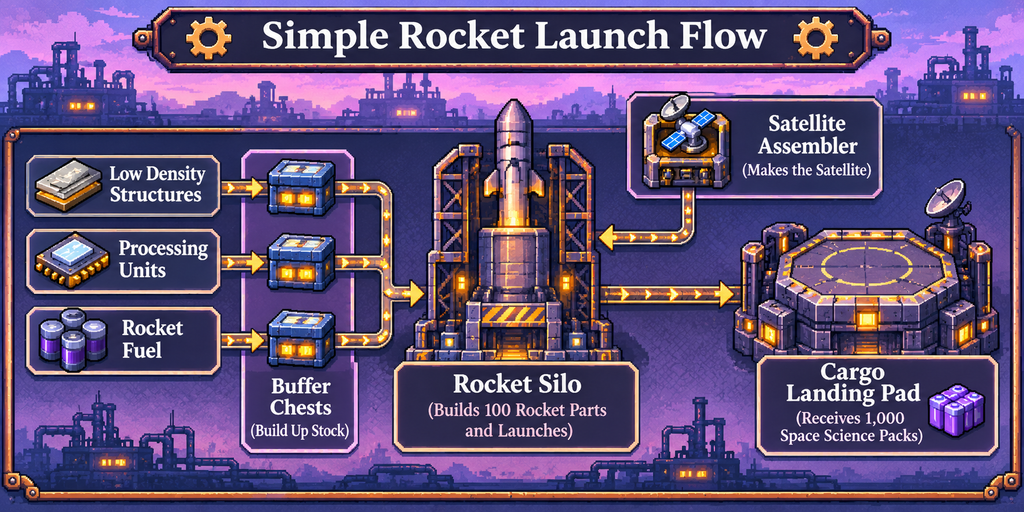
Space science arrives roughly half a minute after launch. If the pad fills up, the wiki says the surplus is dropped on the ground and marked for deconstruction, so empty the pad into storage or a research lab feed rather than letting it clog.
The loop does not need to be fast. One launch per hour is still thousands of packs a night while you do something else. Slow and steady fits this audience better than a high launch rate anyway.
As a version note, Factorio 2.1 reached stable in October 2026. According to the Factorio blog, the headline changes concern space logistics, and the base-game silo got a graphical update rather than a rules change. Always check your own version’s patch notes if a number looks different from what you expect.
🧠 After the Launch: Keep Going or Call It?
Once the victory screen appears, you have a genuine choice. Neither option is wrong, and the best one depends on how the last few sessions felt.
If you are still curious, space science opens the infinite research queue. Mining productivity is a popular first pick because it quietly lowers the burden on every ore patch you own. Each level makes your existing setup go a little further, which suits a relaxed playstyle.
If you feel finished, finish. Plenty of players save the factory, close the game, and come back months later for a new map. A completed run is a good run.
Either way, there is no obligation to pursue a bigger launch rate. Efficiency targets and fast clears are an entirely separate hobby with their own community. They are fun to read about, but nothing in the base game requires you to chase them.
🏗️ If You Want to Keep Building After Victory
Some players find the end of the rocket quest is when the game gets more enjoyable. With no goal left, you can build for the pleasure of it. That might mean tidier layouts, a train network that finally makes sense, or a district-style base you are proud of.
If that appeals, these posts pick up where the launch leaves off. Our megabase guide covers scaling thoughtfully, and factory layouts and expansion strategies shows how to tidy up the spaghetti without starting over.
If you want to revisit research order after your first launch, the science pack optimisation and tech tree post goes through ratios and progression in detail, so there is no need to repeat it here.
Looking for Space Age instead? That expansion changes space science completely, and we cover the latest changes in Factorio Space Age 2.1 and your space logistics. Everything in this post refers to the base game only.
🌟 A Calm Path to the Launch Pad
The endgame feels huge because it is described in giant numbers. Broken into buffers, a power check, a few chests and one satellite, it turns into an ordinary list of jobs.
Pick your finish line, build your stockpiles gradually, and treat each bottleneck as a puzzle rather than a verdict. When the countdown finally runs, you will have earned it, and you can stop or carry on as you please.
🔗 Continue Your Journey
- Science Pack Optimization and Tech Tree Progression in Factorio
- Intermediate Production Chains: Oil, Advanced Materials, and Modules in Factorio
- Using Logistic Robots and Building Logistic Networks in Factorio
- Factorio Megabase Guide: How to Scale Up Your Factory
- Mastering Trains in Factorio: Essential Tips for Efficient Rail Networks


