As an Amazon Associate I earn from qualifying purchases and sometimes recommend products from other sellers at no extra cost you. For more details see my disclosure policy and privacy policy.
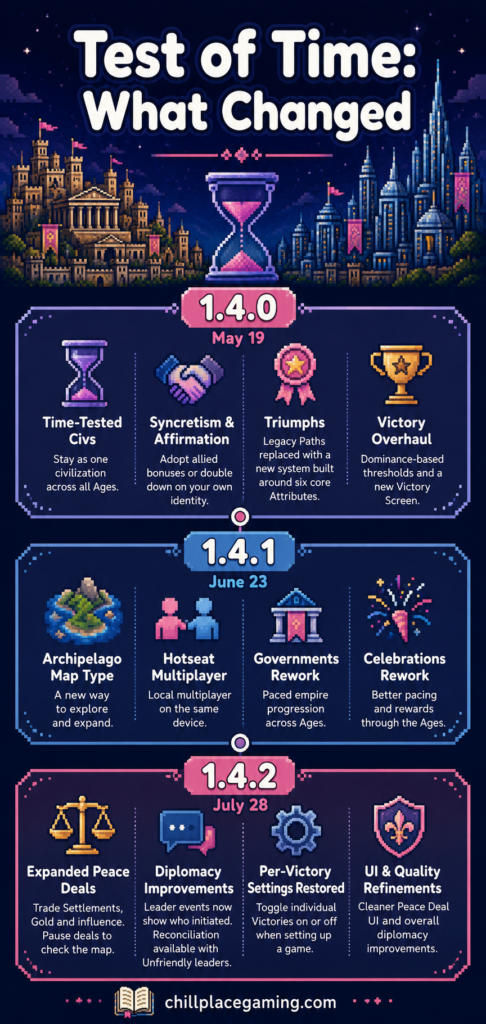
Back in February, our look at update 1.3.2 ended with a promise: something bigger was coming that spring. That something arrived on May 19 as Test of Time (1.4.0), followed by two refinement patches, 1.4.1 (June 23) and 1.4.2 (July 28). Together, these three updates are the most significant changes Civilization VII has seen since launch, and they finally deliver the single-civilization playthrough and Victory overhaul that players had been asking for since day one.
If you read our 1.3.2 anniversary update recap, you know Firaxis was already promising a spring shake-up. The question now is whether it actually landed. Short answer: mostly yes, and it changes how you should be planning your games.
Time-Tested Civs: You Can Finally Stay Put
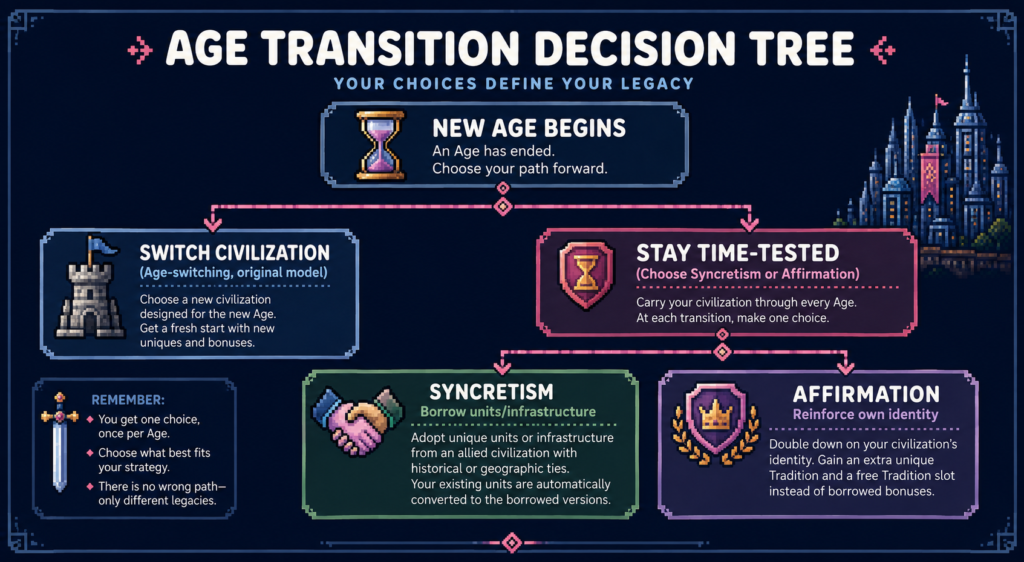
The headline feature of 1.4.0 is Time-Tested Civs, which lets you carry one civilization through every Age instead of switching at each Age transition. This was the single most requested change since launch, and Firaxis built two new mechanics around it: Syncretism and Affirmation.
At each Age transition, a Time-Tested civ unlocks a Syncretism node on its Civic tree. You then make a mutually exclusive choice. Syncretism lets you adopt the unique units or infrastructure from a civilization with historical or geographic ties to yours, automatically converting your existing generic units into the borrowed versions. Affirmation instead doubles down on your own civ’s identity, granting an extra unique Tradition and a free Tradition slot instead of anything borrowed.
Chill Place Gaming Store
Take your game further 🎮
Reference sheets, printable guides, and gaming goodies — made by the Chill Place Gaming team to help you play smarter.
Secure checkout
powered by Shopify
You get one pick, once per Age, for as long as you stay Time-Tested. It is a genuinely clever way to keep a single civ competitive against Apex Age civs (those playing in the Age they were originally designed for), and it opens strategic combinations that did not exist in the original Age-switching design.
Legacy Paths Are Out, Triumphs Are In
Legacy Paths have been fully replaced by Triumphs, a more open system built around the six core Attributes: Militaristic, Cultural, Scientific, Economic, Diplomatic, and Expansionist. Triumphs come in two tiers. Minor Triumphs are easy to hit and grant instant, smaller rewards, like a bonus promotion for your Commanders. Major Triumphs are long-term commitments that pay off with Dedications carried into the next Age.
The practical effect is a much wider range of viable playstyles. Espionage, trade routes, Commander promotions, and Suzerainty are all directly rewarded through Triumphs now, instead of being sidelined by whichever Legacy Path you happened to be chasing.
Victories Got a Real Overhaul
The Victory system was rebuilt around a dominance-based threshold system, with tiers running from Narrow to Transcendent based on how far ahead you are of the second-place civilization. A new Victory Screen, accessible from the Trophy button on the HUD, shows exactly where every player stands across every Victory path in real time.
This is a meaningful shift from the old legacy-point accumulation model, and it is worth revisiting how you approach a run. Our Culture Victory guide and our Science Victory guide were both written before this overhaul, so treat the mechanical breakdowns in those posts as historical reference rather than a current walkthrough until we get them updated.
Reception: The Turnaround Is Real, But Early
Civilization VII launched in February 2025 to a rough reception, sitting around 50% positive on Steam for most of its first year against Civilization VI’s 84% at a similar point. Since Test of Time went live on May 19, that has genuinely shifted. Review scores climbed in the weeks following launch, and multiple outlets reported that daily Steam sentiment stayed net positive for the first time in the game’s history.
Treat “positive reception” as a real, verified trend rather than marketing spin. It is not yet a full reversal of the game’s launch reputation, and it is worth watching whether the improvement holds through the rest of the year.
1.4.1 and 1.4.2: The Follow-Through
1.4.1 (June 23) focused on additions rather than fixes: a new Archipelago map type, Hotseat local multiplayer, and a rework of Governments and Celebrations to better pace empire progression across Ages. It landed alongside the first wave of Brush & Blade DLC content.
1.4.2 (July 28) is where the diplomacy and settings refinements the brief for this piece anticipated actually show up. Peace Deal negotiations were expanded so Gold and Influence can be traded alongside Settlements, with cleaner UI and the ability to pause a deal to check the map before committing. The Leader Relationship panel now shows which leader initiated a given event, and Reconciliation can be offered to Unfriendly leaders instead of only Hostile ones. Per-Victory settings, which had been broken since the Victory rework in May, were also restored, so you can once again toggle individual Victory types on or off when setting up a game.
What This Means for Your Strategy
The old meta assumed you would switch civilizations at every Age transition to chase whichever civ suited your plan best in that Age. That approach still works, and Age-switching has not gone anywhere. Time-Tested play is an additional option, not a replacement, so nothing about your existing leader and civ pairings has become obsolete overnight.
What has changed is the calculus. If you go Time-Tested, your Syncretism and Affirmation choices each Age effectively become your new pairing decisions, replacing “which civ do I switch to” with “what do I borrow or reinforce this Age.” Our Leader and Civilization Combinations guide was built around the old switching-only model, so read it as a foundation for Age-switching strategy specifically, not as coverage of Time-Tested play.
Our Age Transition guide is in a similar spot. The core transition mechanics it covers still apply, but the Legacy Path and Victory sections predate Triumphs and the dominance-threshold system, so read those parts as background rather than current mechanics.
One Practical Note Before You Load an Old Save
If you are picking Civilization VII back up after a break, do not expect your existing saves to show off everything new right away. Reporting around the update indicates Firaxis designed for backward compatibility where possible, but some new abilities and effects only appear once you start a new game or advance into a new Age. If a returning save looks unchanged, that is expected, not a bug.
For anyone considering the game fresh after all this, Test of Time is genuinely the best entry point Civilization VII has had since launch. Picking up Sid Meier’s Civilization VII now means starting with the reworked systems already in place rather than learning the old model first.
The Bottom Line
Test of Time, 1.4.1, and 1.4.2 together represent the biggest strategic shift Civilization VII has had since release. Time-Tested Civs, Triumphs, and the Victory rework change enough fundamentals that several of our older guides need to be read with that context in mind. We will be updating our Victory and Age Transition content to reflect the new systems, but for now, treat this piece as the bridge between what those guides say and what the game actually does today.
Continue Your Journey
- Civilization VII’s 1.3.2 Anniversary Update: UI Polish and Balance Tweaks
- Civilization VII Culture Victory Guide
- Civilization VII Science Victory Guide
- Mastering Leader and Civilization Combinations in Civilization VII
- Civilization VII Age Transition Guide: How to Prepare for Each New Age
- Civilization VII Update 1.3.0: Naval Combat Gets a Complete Overhaul with Tides of Power
Get more strategy tips every week
Join readers who get our weekly roundup covering Cities: Skylines II, Factorio, Civ VII, and more.